
Why Aerospace Engineers Choose Titanium Over Aluminum and Steel
An in-depth look at why titanium dominates modern aircraft design — from structural weight savings and fatigue performance to engine temperature resistance — with real application data from commercial and military programs.
The Material That Changed Aviation
When Boeing designed the 787 Dreamliner, they made a decision that would reshape the global titanium supply chain: approximately 15% of the aircraft's structural weight — over 130,000 pounds of finished parts per airframe — would be titanium. The 787 uses more titanium than any previous commercial aircraft in history, and the trend has only accelerated with subsequent programs. Understanding why aerospace engineers consistently choose titanium over aluminum alloys and high-strength steels reveals fundamental material advantages that no alternative can replicate.
The aerospace industry currently consumes approximately 40% of global titanium mill product output, making it the single largest end-use market. This demand is driven not by fashion or convention, but by a clear-eyed engineering assessment of what titanium delivers in the specific operating environments that define modern aircraft performance: high stress ratios at moderate temperatures, prolonged fatigue cycling, and exposure to both cryogenic fuel tanks and hot-section engine environments within the same airframe.
The Three Fundamental Advantages
Strength-to-Weight Ratio
The defining advantage of titanium in aerospace applications is its exceptional specific strength — the ratio of tensile strength to density. Ti-6Al-4V (Grade 5), the dominant aerospace titanium alloy, delivers tensile strength of 895–1100 MPa at a density of only 4.43 g/cm³. To contextualize this performance:
| Material | Density (g/cm³) | Tensile (MPa) | Specific Strength (MPa·cm³/g) |
|---|---|---|---|
| Ti-6Al-4V | 4.43 | 950 | 214 |
| 7075-T6 Aluminum | 2.81 | 572 | 204 |
| 4340 Steel (HT) | 7.85 | 1793 | 228 |
| 15-5PH Stainless | 7.78 | 1310 | 168 |
| Inconel 718 | 8.19 | 1241 | 152 |
While high-strength steel achieves similar or higher specific strength on paper, the comparison is misleading for aerospace design. Steel's density penalty means that structural members must carry their own weight through the flight envelope, and this self-weight compounds through the entire airframe structure. In practice, replacing a steel landing gear beam with Ti-6Al-4V saves approximately 40% weight at equivalent load-carrying capacity — and every kilogram saved in the landing gear reduces the wing structure, fuel system, and airframe that must support it.
For aluminum, the comparison is more nuanced. Aluminum alloys like 7075-T6 offer excellent specific strength and have been the backbone of aircraft structures since the 1930s. Titanium's advantage over aluminum emerges in three specific conditions: temperatures above 130°C (where aluminum loses significant strength), environments where galvanic corrosion with carbon fiber composites is a concern, and applications requiring compact, high-load fittings where the higher absolute strength of titanium allows thinner sections.
Fatigue Performance
Aircraft structures experience millions of load cycles over their design life — pressurization cycles in the fuselage, gust loads on the wing, and landing impact on the gear. Fatigue crack initiation and growth behavior is therefore a critical design parameter, and titanium's performance in this domain is outstanding.
Ti-6Al-4V exhibits a well-defined fatigue endurance limit at approximately 500 MPa — meaning that at stress levels below this threshold, the material can theoretically sustain an infinite number of load cycles without crack initiation. This behavior is fundamentally different from aluminum alloys, which have no true endurance limit and will eventually develop fatigue cracks at any cyclic stress level given sufficient cycles. In practical terms, this means titanium structural components can be designed to a safe-life rather than damage-tolerant philosophy in certain applications, simplifying inspection requirements and extending service intervals.
The Extra Low Interstitial variant, Ti-6Al-4V ELI (Grade 23), further improves fatigue performance by reducing oxygen, nitrogen, and carbon levels. This grade achieves fracture toughness values of 75–100 MPa√m compared to 55–75 MPa√m for standard Grade 5, and is specified for the most fatigue-critical applications including landing gear components, wing attachment fittings, and engine fan blade dovetails.
Temperature Resistance
Modern turbofan engines present a demanding thermal environment that spans from -55°C at cruise altitude to over 600°C in the compressor section. Titanium alloys serve effectively across a wide portion of this range:
| Temperature Zone | Typical Range | Material | Application |
|---|---|---|---|
| Cryogenic | -250°C to -55°C | Ti-6Al-4V ELI | Fuel tanks, cryogenic piping |
| Ambient structural | -55°C to 130°C | Ti-6Al-4V | Fuselage frames, wing spars |
| Warm structural | 130°C to 315°C | Ti-6Al-4V | Engine nacelle, pylon |
| Hot section | 315°C to 540°C | Ti-6242, Ti-6246 | Compressor discs, blades |
| Very hot | >540°C | Nickel superalloys | Turbine section |
Aluminum alloys lose approximately 50% of their room-temperature strength at 200°C, effectively limiting their use to the cooler regions of the airframe. Titanium alloys maintain useful strength up to 540°C with specialized near-alpha compositions like Ti-6Al-2Sn-4Zr-2Mo (Ti-6242), which was specifically developed for jet engine compressor applications where creep resistance at elevated temperature is the primary design requirement.
Where Titanium Goes on an Aircraft
Airframe Structure
The largest volume application for aerospace titanium is in primary airframe structure — the load-carrying skeleton that transfers flight loads, pressurization loads, and landing loads through the aircraft. Typical components include:
Fuselage: Bulkheads, keel beams, window frames, door surrounds, and floor beams. In composite-intensive designs like the 787 and A350, titanium is used extensively at the interface between composite skins and metallic fittings, where aluminum would suffer galvanic corrosion in contact with carbon fiber.
Wing: Spar caps, root fittings, carry-through structures, and wing-to-body fairings. The wing root attachment — arguably the most structurally critical joint in any aircraft — is almost universally titanium in modern designs due to the combination of high strength, fatigue resistance, and compact fitting geometry.
Empennage: Horizontal and vertical stabilizer attach fittings, hinge brackets, and actuator supports.
Landing Gear
Landing gear represents one of the highest-value applications for titanium forgings. The main landing gear beams, trucks, and axles on wide-body aircraft are massive titanium forgings — individual components can weigh over 1,000 kg in their forged state. Ultra-high-strength beta titanium alloys like Ti-5Al-5V-5Mo-3Cr (Ti-5553) and Ti-10V-2Fe-3Al (Ti-10-2-3) have been developed specifically for these applications, achieving yield strengths exceeding 1,200 MPa after solution treating and aging — sufficient to replace 300M steel at 40% weight savings.
Jet Engines
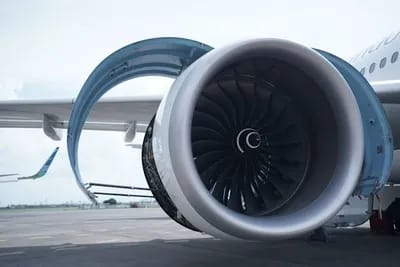
In the engine, titanium dominates the cold section — the fan, low-pressure compressor, and portions of the high-pressure compressor. Fan blades, fan cases, compressor discs (also called "blisks" when blades are integral), compressor spacers, and inlet guide vanes are predominantly titanium. The fan case is a particularly demanding application: it must contain a released fan blade in the event of blade failure, requiring exceptional impact toughness and ductility in a large-diameter ring forging.
Fasteners
Though small in individual mass, titanium fasteners represent a significant portion of total aerospace titanium consumption due to sheer quantity — a single wide-body aircraft can contain over 300,000 fasteners. Ti-6Al-4V bolts, nuts, and collar systems are used throughout composite and titanium structural joints where steel fasteners would introduce galvanic corrosion concerns.
Quality and Certification Requirements
Aerospace titanium procurement operates within a rigorous quality framework that reflects the safety-critical nature of the application. The key certifications and standards that govern the titanium supply chain include:
AS9100D — The aerospace quality management system standard, equivalent to ISO 9001 but with additional requirements for configuration management, risk management, and customer-specific requirements (e.g., Boeing D6-82479, Airbus AIMS).
Nadcap — The National Aerospace and Defense Contractors Accreditation Program, which provides specialized process accreditation for heat treatment, non-destructive testing, chemical processing, and materials testing. Nadcap accreditation is effectively mandatory for any supplier shipping titanium to Boeing, Airbus, Rolls-Royce, GE Aviation, Pratt & Whitney, or Safran.
Material Specifications — Aerospace titanium is procured to material specifications that define chemistry, mechanical properties, microstructure, non-destructive testing, and traceability requirements in granular detail. AMS 4911 (sheet and plate), AMS 4928 (bars and forgings), AMS 4967 (bars for high-strength applications), and MIL-T-9046 (military sheet and plate) are among the most commonly invoked specifications.
Full Traceability — Every piece of aerospace titanium must be traceable from the final component back through machining, heat treatment, forging, melting, and raw material sourcing. This "cradle-to-grave" traceability is documented through EN 10204 3.1 or 3.2 mill test reports, which travel with the material through the entire manufacturing chain.
Key Takeaways
- Titanium accounts for 15% of the Boeing 787's structural weight — over 130,000 pounds per aircraft — driven by its unmatched combination of strength, fatigue resistance, and composite compatibility.
- Ti-6Al-4V is the dominant aerospace alloy, representing over 50% of global titanium consumption, with specialized variants (ELI, Ti-6242, Ti-5553) for fatigue-critical, high-temperature, and ultra-high-strength applications respectively.
- Weight savings of 40% versus steel in structural applications like landing gear beams and wing fittings, with corresponding reductions in fuel consumption and operating costs across the aircraft's 25+ year service life.
- Fatigue endurance limit of ~500 MPa gives titanium a fundamental advantage over aluminum alloys for long-life structural components, simplifying inspection programs and extending service intervals.
- Temperature capability up to 540°C with near-alpha alloys enables titanium to serve in jet engine compressor sections where aluminum cannot operate, while maintaining structural integrity from cryogenic fuel tank temperatures to hot nacelle environments.
- Aerospace procurement requires AS9100D, Nadcap, and full material traceability — certifications that BAOTI maintains across all production systems from melting through final testing.
BAOTI is a qualified titanium supplier for major aerospace OEM programs, with AS9100D certification, Nadcap accreditation for heat treatment and NDT, and 50+ years of experience producing aerospace-grade plate, bar, forgings, and tube in Ti-6Al-4V, Ti-6242, Ti-5553, and other aerospace alloys. For aerospace titanium inquiries, contact our aerospace sales team — we provide technical evaluations and quotations within 48 hours.
Frequently Asked Questions
Why is titanium used in aircraft instead of aluminum?
Titanium supplements aluminum in aircraft structures where its specific advantages are needed: temperatures above 130°C (where aluminum loses strength), contact with carbon fiber composites (where aluminum corrodes galvanically), high-load compact fittings (where titanium's higher absolute strength allows thinner sections), and fatigue-critical joints (where titanium's endurance limit provides inherent safe-life capability that aluminum cannot match). The Boeing 787 uses over 130,000 pounds of titanium per airframe — approximately 15% of structural weight.
What titanium grade is used in jet engines?
Ti-6Al-4V (Grade 5) dominates the fan and low-pressure compressor sections, serving at temperatures up to 315°C. For higher-temperature compressor stages up to 540°C, near-alpha alloys Ti-6Al-2Sn-4Zr-2Mo (Ti-6242) and Ti-6Al-2Sn-4Zr-6Mo (Ti-6246) are specified for their superior creep resistance. Above 540°C, nickel-based superalloys replace titanium in the turbine section.
How much weight does titanium save compared to steel in aerospace?
Replacing high-strength steel with titanium alloys in aerospace structural applications typically saves approximately 40% weight at equivalent load-carrying capacity. In landing gear applications, this translates to individual component weight savings of several hundred kilograms on wide-body aircraft. These savings compound through the airframe design — lighter gear means lighter support structure, smaller hydraulics, and reduced fuel consumption over the aircraft's 25+ year operational life.
What certifications are required for aerospace titanium?
Aerospace titanium suppliers must hold AS9100D quality management certification, Nadcap accreditation for relevant special processes (heat treatment, NDT, materials testing), and the ability to produce material to AMS, MIL, and customer-specific specifications. Full material traceability from finished component back to raw material melt is mandatory, documented through EN 10204 3.1 or 3.2 mill test reports. Major OEM approvals (Boeing, Airbus) require additional qualification audits.
What is the difference between Ti-6Al-4V and Ti-5553 in aerospace?
Ti-6Al-4V is an alpha-beta alloy with tensile strength of 895–1100 MPa, used for the majority of aerospace structural applications including airframe fittings, engine components, and fasteners. Ti-5Al-5V-5Mo-3Cr (Ti-5553) is a metastable beta alloy that can achieve yield strengths exceeding 1,200 MPa after solution treating and aging. Ti-5553 was developed specifically for thick-section landing gear forgings where Ti-6Al-4V cannot achieve adequate hardenability — the alloy's deep hardenability allows full strength development in sections over 150mm thick.
Related Reading

Titanium Forging: Process Comparison, Grade Selection, and Cost-Per-Part Data for OEM Procurement
A data-driven comparison of titanium forging processes — open-die, closed-die, and precision forging — with mechanical property tables, grade-by-grade cost analysis, and procurement guidance for aerospace, medical, and industrial OEM buyers.

How to Select the Right Titanium Grade for Your Application
A comprehensive guide to titanium grade selection covering commercially pure grades, alpha-beta alloys, corrosion-resistant specialty grades, and medical grades — with clear recommendations for every major industry application.

TITANIUM USA 2026: What Buyers and Engineers Should Expect at This Year's Premier Titanium Conference
A preview of TITANIUM USA 2026, the International Titanium Association's annual conference and exhibition in Orlando — covering key themes, exhibitor highlights, technical sessions on additive manufacturing and sustainability, and practical guidance for attendees planning procurement meetings.

Farnborough International Airshow 2026 Highlights: 1,200+ Exhibitors Gather for the World's Largest Aerospace Trade Event
The Farnborough International Airshow 2026 brought together over 1,200 exhibitors and 80,000 trade visitors in Hampshire, UK, featuring aerospace giants Airbus, Boeing, Safran, and Rolls-Royce. BAOTI attended the event to connect with global aerospace buyers and explore new partnership opportunities.