
Grade 2 vs Grade 5 Titanium: A Head-to-Head Comparison for Engineers and Buyers
A direct comparison of the two most widely specified titanium grades — commercially pure Grade 2 and alloy Grade 5 (Ti-6Al-4V) — covering mechanical properties, corrosion behavior, machinability, cost, and decision criteria by application.
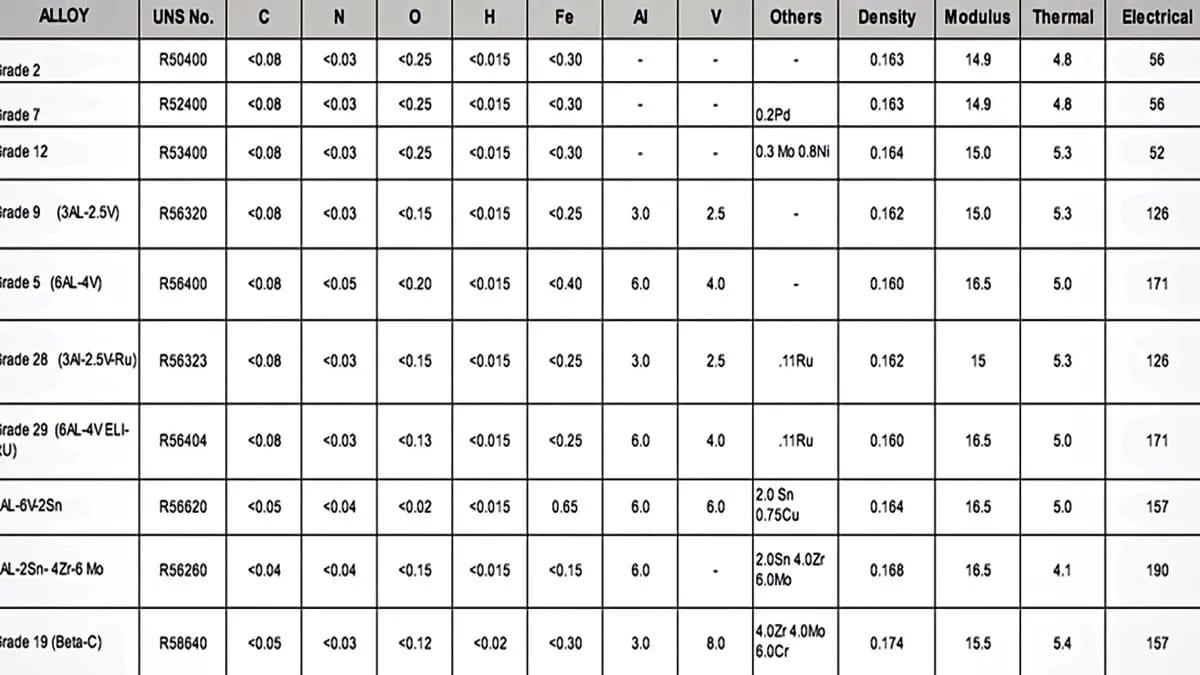
Grade 2 and Grade 5 together account for over 80 percent of all titanium mill product consumption worldwide. Every titanium purchasing decision eventually comes down to a version of the same question: does this application need the strength of Grade 5, or will Grade 2 do the job at lower cost? The answer is not always obvious, and getting it wrong in either direction — over-specifying Grade 5 where Grade 2 suffices, or under-specifying Grade 2 where Grade 5 is needed — costs money and can compromise performance.
Property Comparison
| Property | Grade 2 (CP Ti) | Grade 5 (Ti-6Al-4V) | Difference |
|---|---|---|---|
| UNS | R50400 | R56400 | — |
| Density (g/cm³) | 4.51 | 4.43 | Grade 5 is 2% lighter |
| UTS (MPa) | ≥345 | ≥895 | Grade 5 is 2.6× stronger |
| Yield strength (MPa) | ≥275 | ≥828 | Grade 5 is 3× higher |
| Elongation (%) | ≥20 | ≥10 | Grade 2 is 2× more ductile |
| Hardness | ~80 HRB | ~36 HRC | Grade 5 is significantly harder |
| Fatigue limit (MPa) | ~230 | ~510 | Grade 5 is 2.2× higher |
| Elastic modulus (GPa) | 103 | 114 | Similar |
| Max service temp (°C) | 250 | 315 | Grade 5 handles higher temps |
| Thermal conductivity (W/m·K) | 16.4 | 6.7 | Grade 2 conducts heat 2.4× better |
| Weldability | Excellent | Good (requires care) | Grade 2 is easier to weld |
| Machinability (relative) | 1.0× | 0.6× | Grade 2 machines 40% faster |
| Raw material cost | 1.0× | 1.8–2.2× | Grade 5 costs nearly double |
The table reveals Grade 5's core value proposition: it delivers 2.6 times the tensile strength at only twice the cost. For applications where strength drives the design, Grade 5 actually offers better value per unit of strength. But for applications where corrosion resistance is the primary requirement and strength is secondary, Grade 2 delivers equivalent corrosion performance at half the price.
Corrosion Resistance: Nearly Identical
Both grades form the same protective TiO₂ passive film, and both are effectively immune to corrosion in seawater, most organic acids, and chloride environments. The corrosion behavior diverges only in a few specific conditions:
- Reducing acids (HCl, H₂SO₄): Both grades are vulnerable. Grade 7 (Ti-0.15Pd) or Grade 12 (Ti-0.3Mo-0.8Ni) is preferred for these environments.
- High-temperature oxidation: Grade 5 maintains its oxide layer at higher temperatures (315 °C vs 250 °C), giving it an advantage in hot, oxidizing environments.
- Crevice corrosion in hot brines: Grade 2 can experience crevice corrosion above 70 °C in concentrated brines. Grade 5 resists crevice corrosion to approximately 100 °C.
For the vast majority of industrial corrosion applications — seawater piping, chemical process equipment, desalination, chlor-alkali — Grade 2 and Grade 5 perform identically, making Grade 2 the clear economic choice.
When to Specify Grade 2
- Heat exchangers and condensers — Grade 2's higher thermal conductivity (16.4 vs 6.7 W/m·K) improves heat transfer efficiency. Its superior ductility simplifies tube expansion into tubesheets.
- Chemical process vessels and piping — Corrosion resistance drives the material selection; strength is secondary. Grade 2 welds more easily and costs less.
- Desalination equipment — Long service life in seawater at moderate temperatures. Grade 2 is the industry standard.
- Architectural and decorative applications — Forming, bending, and deep drawing are easier with Grade 2's higher elongation.
- Electrochemical anodes — Grade 2 is the standard substrate for mixed metal oxide (MMO) anodes in cathodic protection systems.
When to Specify Grade 5
- Aerospace structural components — Landing gear, engine mounts, bulkheads, and fasteners where strength-to-weight ratio is the primary design driver.
- High-cycle fatigue applications — Grade 5's fatigue limit of 510 MPa (vs 230 MPa for Grade 2) makes it essential for rotating machinery, vibrating structures, and any part subjected to millions of load cycles.
- Medical implants — Grade 5 ELI (Grade 23) is the standard for orthopedic implants. The higher strength allows smaller, less invasive implant designs.
- Elevated temperature service (250–315 °C) — Grade 5 retains adequate strength at temperatures where Grade 2 softens.
- High-pressure equipment — Pressure vessel and valve body designs benefit from Grade 5's higher yield strength, which allows thinner walls and lighter assemblies.
- Racing and high-performance applications — Connecting rods, exhaust systems, suspension components where weight reduction is paramount.
Machining and Fabrication Differences
Grade 2 is significantly easier to work with:
| Operation | Grade 2 | Grade 5 |
|---|---|---|
| Turning speed (m/min) | 90–120 | 45–65 |
| Tool life (relative) | 1.0× | 0.4–0.6× |
| Bending (min bend radius) | 1.5T | 3T |
| Welding | Standard TIG, no preheat | TIG with trailing shield, controlled interpass temp |
| Cold forming | Readily formed | Limited, spring-back issues |
These fabrication differences translate directly into part cost. A component machined from Grade 2 typically costs 30–40 percent less in machining labor and tooling than the same geometry in Grade 5, on top of the raw material savings.
Decision Framework
Ask two questions:
Is the application strength-critical or fatigue-critical?
- Yes → Grade 5
- No → Grade 2
Does the design benefit from reduced wall thickness or lighter weight?
- Yes, and the weight savings justify the cost premium → Grade 5
- No → Grade 2
If both answers point to Grade 2, there is no engineering justification for specifying Grade 5 — you would simply be paying more for strength you do not need. If either answer points to Grade 5, run a lifecycle cost comparison to confirm that the performance benefit justifies the material and machining premium.
BAOTI supplies both Grade 2 and Grade 5 in all standard mill product forms — bar, sheet, plate, tube, wire, and forgings — with full ASTM and AMS certification. Our technical team can review your application requirements and recommend the grade that optimizes both performance and cost.
Frequently Asked Questions
What is the main difference between Grade 2 and Grade 5 titanium?
Grade 2 is commercially pure titanium (345 MPa tensile) optimized for corrosion resistance and formability. Grade 5 (Ti-6Al-4V) is an alpha-beta alloy (895 MPa tensile) optimized for strength-to-weight ratio. Grade 5 is 2.6× stronger but costs 1.8–2.2× more and machines 40% slower.
Is Grade 5 titanium more corrosion resistant than Grade 2?
In most environments they perform identically — both form the same protective TiO₂ film and are immune to seawater and chloride corrosion. Grade 5 has a slight advantage in hot brine crevice corrosion (resistant to ~100°C vs ~70°C for Grade 2) and higher-temperature oxidation resistance.
When should I choose Grade 2 over Grade 5 titanium?
Choose Grade 2 when corrosion resistance is the primary requirement and high strength is not needed — heat exchangers, chemical process vessels, desalination equipment, and piping. Grade 2 costs roughly half as much, machines 40% faster, and welds more easily than Grade 5.
Which titanium grade is used for medical implants?
Grade 5 ELI (Grade 23, Ti-6Al-4V Extra Low Interstitials) is the standard for orthopedic implants including hip joints, knee replacements, and spinal hardware. The ELI variant has lower oxygen and iron content, providing superior fracture toughness and fatigue resistance for long-term implant performance.
How much does Grade 5 titanium cost compared to Grade 2?
Grade 5 raw material typically costs 1.8–2.2× more than Grade 2 per kilogram. Total part cost is even higher because Grade 5 machines approximately 40% slower with shorter tool life. However, for strength-critical applications, Grade 5 can be more cost-effective because thinner, lighter designs reduce overall material usage.
Related Reading

Commercially Pure Titanium: Grades 1 Through 4 Explained for Industrial Buyers
A concise guide to the four CP titanium grades — Grade 1, 2, 3, and 4 — explaining how oxygen content controls strength and ductility, which grade fits which application, and how to avoid the common specification mistakes that lead to material substitution or part failure.

Specialty Titanium Alloys Explained: When to Specify Grade 7, Grade 9, Grade 12, and Grade 23
While Grade 2 and Grade 5 account for most industrial volume, extreme environments require specialty titanium alloys. This engineering guide compares Grade 7 (Ti-Pd), Grade 9 (Ti-3Al-2.5V), Grade 12 (Ti-Mo-Ni), and Grade 23 (Ti-6Al-4V ELI) across corrosion limits, mechanical properties, and cost.

Why Aerospace Engineers Choose Titanium Over Aluminum and Steel
An in-depth look at why titanium dominates modern aircraft design — from structural weight savings and fatigue performance to engine temperature resistance — with real application data from commercial and military programs.

How to Select the Right Titanium Grade for Your Application
A comprehensive guide to titanium grade selection covering commercially pure grades, alpha-beta alloys, corrosion-resistant specialty grades, and medical grades — with clear recommendations for every major industry application.