
Commercially Pure Titanium: Grades 1 Through 4 Explained for Industrial Buyers
A concise guide to the four CP titanium grades — Grade 1, 2, 3, and 4 — explaining how oxygen content controls strength and ductility, which grade fits which application, and how to avoid the common specification mistakes that lead to material substitution or part failure.
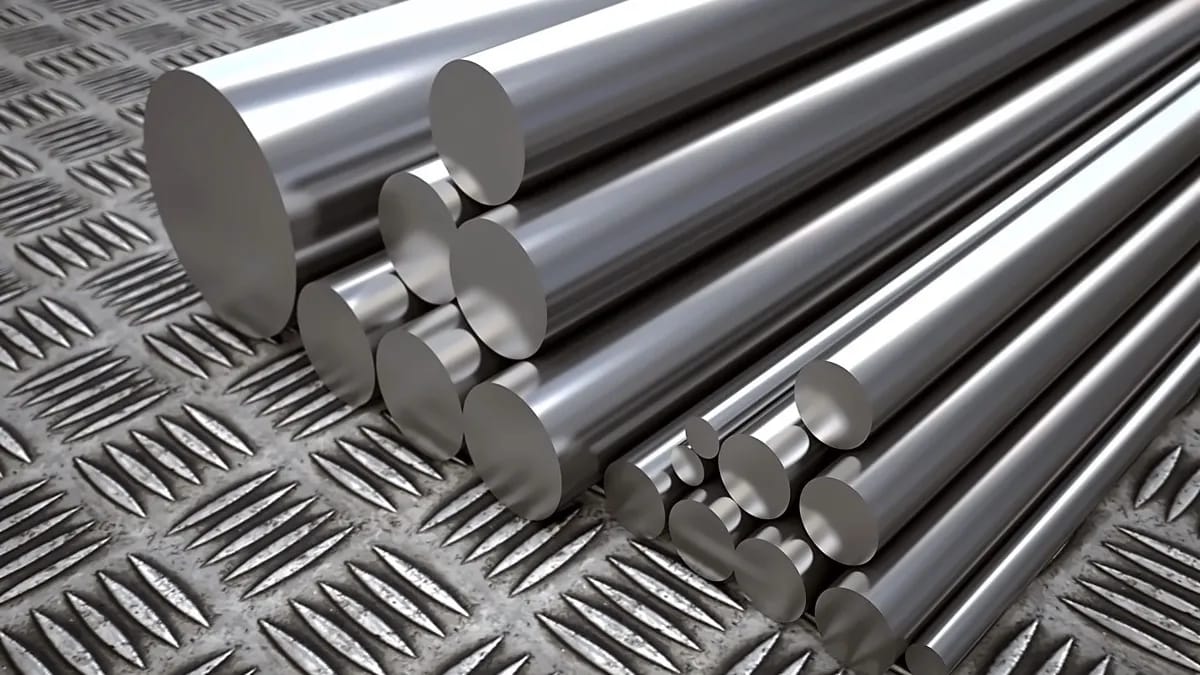
Commercially pure (CP) titanium is not a single material — it is a family of four grades whose properties vary significantly based on one primary variable: oxygen content. Understanding this relationship is essential for procurement engineers, because specifying the wrong CP grade can result in parts that crack during forming (too strong, not ductile enough) or fail under load (too ductile, not strong enough).
The Oxygen-Strength Relationship
Oxygen is the most important interstitial element in CP titanium. It occupies interstitial sites in the hexagonal close-packed (HCP) crystal lattice, pinning dislocations and increasing resistance to plastic deformation. The result is a direct, predictable relationship: more oxygen means higher strength but lower ductility.
| Grade | Max Oxygen (wt%) | UTS (MPa) | YS (MPa) | Elongation (%) | Character |
|---|---|---|---|---|---|
| Grade 1 | 0.18 | ≥240 | ≥170 | ≥24 | Softest, most formable |
| Grade 2 | 0.25 | ≥345 | ≥275 | ≥20 | Standard workhorse |
| Grade 3 | 0.35 | ≥450 | ≥380 | ≥18 | Higher strength, moderate formability |
| Grade 4 | 0.40 | ≥550 | ≥483 | ≥15 | Strongest CP, limited forming |
All four grades have identical density (4.51 g/cm³), identical corrosion resistance, identical thermal and electrical conductivity, and identical weldability characteristics. The only differences are mechanical — strength and ductility — driven almost entirely by oxygen.
Grade 1: Maximum Formability
Grade 1 is the softest CP titanium, with the lowest oxygen content and highest elongation. It is specified when the manufacturing process requires extensive forming — deep drawing, spinning, severe bending — or when the application requires maximum ductility for impact resistance.
Typical applications:
- Plate heat exchanger gasket plates (deep-drawn corrugated patterns)
- Explosive cladding of steel vessels (Grade 1 clad layer)
- Chemical process linings where forming to complex shapes is required
- Jewelry and decorative items requiring intricate forming
Buyer tip: Grade 1 is less commonly stocked than Grade 2, so lead times can be 2–4 weeks longer. If your design can accept Grade 2's slightly lower ductility, you gain better availability and lower cost.
Grade 2: The Industry Standard
Grade 2 accounts for approximately 60 percent of all CP titanium consumption. It offers the best balance of strength, formability, weldability, and cost. When a specification simply calls for "commercially pure titanium" without stating a grade, Grade 2 is the default assumption.
Typical applications:
- Shell-and-tube heat exchangers (ASTM B338 tubing)
- Chemical process vessels and piping
- Desalination plant components
- Marine hardware and propeller shafts
- Electrochemical anodes and cathode baskets
- Architectural cladding
Buyer tip: Always specify "Grade 2" explicitly, not just "CP titanium." Some suppliers may substitute Grade 1 (weaker) or Grade 3 (less ductile) if the grade is not clearly stated.
Grade 3: The Overlooked Middle Ground
Grade 3 is the least commonly specified CP grade, but it fills a useful niche: applications that need more strength than Grade 2 but don't require — or can't afford — an alloy grade like Grade 5. Its yield strength of 380 MPa approaches the low end of alloy territory while maintaining the easy weldability and corrosion resistance of CP titanium.
Typical applications:
- Pressure vessel shells where ASME Code calculations favor higher allowable stress
- Piping systems designed to ASME B31.3 where Grade 2's allowable stress is marginally insufficient
- Structural components in chemical plants where weight reduction versus steel is desired but Grade 5 is overkill
Buyer tip: Grade 3 availability is limited. Discuss with your supplier whether Grade 3 material is in stock or whether a mill production run is required. In some cases, a Grade 2 sheet or plate from the upper end of the oxygen range will meet Grade 3 minimums — your supplier can advise.
Grade 4: Maximum Strength in CP
Grade 4 delivers the highest strength of any CP titanium grade — 550 MPa tensile, approaching the territory of some low-alloy steels — while retaining the corrosion resistance that makes titanium valuable. However, its 15 percent minimum elongation limits forming capability.
Typical applications:
- Dental implant abutments and frameworks (ASTM F67 Grade 4)
- Orthodontic brackets
- Aircraft ducting and non-structural sheet metal
- Fasteners where CP corrosion resistance is needed at higher preload
Buyer tip: In the medical device market, Grade 4 competes directly with Grade 5 ELI (Grade 23) for dental and small orthopedic implants. Grade 4 is preferred when bone-bonding (osseointegration) is the priority, as CP titanium's surface oxide promotes cell attachment slightly better than Ti-6Al-4V in some studies.
Common Specification Mistakes
Mistake 1: Specifying Grade 1 when Grade 2 is sufficient. Grade 1 costs more and has longer lead times because it is produced in smaller volumes. Unless your forming operations specifically require the extra ductility, Grade 2 is the better choice.
Mistake 2: Specifying Grade 2 for dental implants. Dental implant abutments require the higher strength of Grade 4 (or Grade 5 ELI). Grade 2 abutments are prone to fracture under occlusal loading.
Mistake 3: Not specifying the grade at all. Purchase orders that read "titanium sheet per ASTM B265" without stating the grade leave the decision to the supplier. You may receive Grade 1, 2, 3, or 4 — all of which meet ASTM B265 but have very different mechanical properties.
Mistake 4: Assuming all CP grades weld identically. While all four grades weld well, the higher oxygen content of Grade 3 and Grade 4 makes them slightly more susceptible to weld embrittlement if shielding gas coverage is inadequate. Welding procedures qualified for Grade 2 should be revalidated when moving to Grade 3 or 4.
BAOTI CP Titanium Products
BAOTI produces all four CP grades in bar, sheet, plate, tube, wire, and forging forms. Our CP titanium starts from high-purity sponge with controlled oxygen addition during the VAR melting process, ensuring that each grade meets its specification range consistently. We supply to ASTM, AMS, ASME, and medical device standards with full MTR documentation on every shipment.
Frequently Asked Questions
What is the difference between Grade 1, 2, 3, and 4 titanium?
The four CP titanium grades differ primarily in oxygen content, which controls strength and ductility. Grade 1 (0.18% O max) is softest and most formable. Grade 2 (0.25% O) is the standard workhorse. Grade 3 (0.35% O) offers higher strength. Grade 4 (0.40% O) is the strongest CP grade at 550 MPa tensile. All four have identical corrosion resistance.
Which commercially pure titanium grade is most commonly used?
Grade 2 accounts for approximately 60% of all CP titanium consumption worldwide. It offers the best balance of strength (345 MPa tensile), formability (20% elongation), weldability, availability, and cost. It is the default choice for heat exchangers, chemical processing, desalination, and marine applications.
What CP titanium grade is used for dental implants?
Grade 4 (ASTM F67 Grade 4) is the standard for dental implant abutments and frameworks. Its higher strength (550 MPa) handles occlusal loading better than Grade 2, while CP titanium's surface oxide promotes better osseointegration (bone bonding) than Ti-6Al-4V alloys in some clinical studies.
Related Reading

Grade 2 vs Grade 5 Titanium: A Head-to-Head Comparison for Engineers and Buyers
A direct comparison of the two most widely specified titanium grades — commercially pure Grade 2 and alloy Grade 5 (Ti-6Al-4V) — covering mechanical properties, corrosion behavior, machinability, cost, and decision criteria by application.

Titanium vs. Steel (Carbon and Alloy Steel): Strength-to-Weight, Density, and Lifecycle Cost
How does titanium compare against carbon steel and high-strength alloy steels like 4140 and 4340? This data-driven engineering comparison covers density, specific strength, elastic modulus, thermal properties, fatigue endurance, and total lifecycle economics.

Specialty Titanium Alloys Explained: When to Specify Grade 7, Grade 9, Grade 12, and Grade 23
While Grade 2 and Grade 5 account for most industrial volume, extreme environments require specialty titanium alloys. This engineering guide compares Grade 7 (Ti-Pd), Grade 9 (Ti-3Al-2.5V), Grade 12 (Ti-Mo-Ni), and Grade 23 (Ti-6Al-4V ELI) across corrosion limits, mechanical properties, and cost.

Titanium vs Aluminum: When to Upgrade and When Aluminum Is Good Enough
A practical engineering comparison of titanium and aluminum alloys — covering strength-to-weight ratio, corrosion resistance, temperature limits, cost per part, and decision criteria for aerospace, marine, chemical, and medical applications.