
CNC Machining Titanium: Cutting Parameters, Tool Selection, and Cost Reduction Strategies for Production Shops
A practical engineering guide to CNC machining titanium alloys — covering why titanium is difficult to cut, optimal speeds and feeds for common grades, tooling strategies that extend tool life by 3–5x, and real-world cost data from production environments.
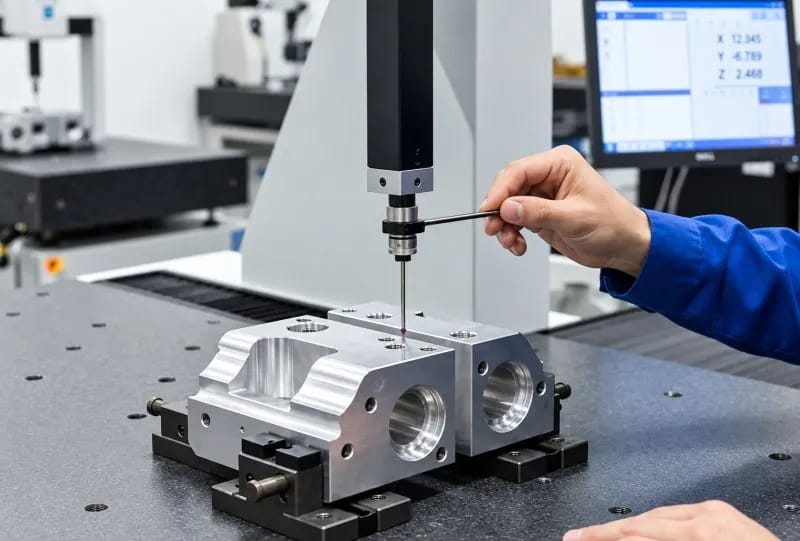
Titanium has a reputation for being difficult to machine. That reputation is earned — but it is also frequently overstated by shops that apply steel-cutting parameters to a material that demands a fundamentally different approach. When the cutting parameters, tooling, and coolant strategy are correctly matched to titanium's unique material properties, cycle times and tool costs fall dramatically. This guide provides the quantitative framework that production shops and OEM procurement teams need to machine titanium efficiently and profitably.
Why Titanium Is Hard to Cut — and Why It Matters
Titanium's machinability challenges stem from four physical properties that interact during the cutting process:
Low thermal conductivity. Titanium conducts heat at roughly 7 W/m·K — about one-sixth that of steel and one-twenty-fifth that of aluminum. During cutting, heat generated at the tool-chip interface cannot dissipate into the workpiece or the chip. Instead, it concentrates in the cutting edge, accelerating tool wear through diffusion, adhesion, and plastic deformation of the tool substrate.
High chemical reactivity at elevated temperatures. Above approximately 500 °C, titanium reacts aggressively with carbon, nitrogen, and oxygen. At the cutting edge, where temperatures can exceed 800 °C during aggressive cuts, titanium welds to the tool face (built-up edge formation) and chemically attacks carbide binders and coatings. This is the primary reason why titanium destroys tooling that performs well in steel.
Low elastic modulus. Titanium's elastic modulus (approximately 114 GPa for Ti-6Al-4V, compared to 200 GPa for steel) means that the workpiece deflects under cutting forces. This spring-back effect causes rubbing on the tool flank, generating additional heat and accelerating flank wear. It also makes dimensional control more challenging, particularly on thin-walled features.
Work hardening. Titanium alloys — particularly alpha-beta grades like Ti-6Al-4V — work-harden rapidly during deformation. If the tool dwells or rubs without actively cutting (as can happen with dull edges or insufficient chip load), the surface layer hardens, making subsequent passes more difficult and accelerating wear further.
Understanding these four mechanisms is essential because every parameter decision — speed, feed, depth of cut, tool geometry, coolant pressure — is ultimately a strategy for managing heat and avoiding the conditions that trigger rapid tool failure.
Cutting Parameters by Grade
The table below provides starting-point parameters for the most commonly machined titanium grades. These values assume carbide tooling with appropriate coatings and high-pressure coolant (70+ bar). Adjust based on machine rigidity, toolpath strategy, and required surface finish.
Turning Parameters
| Grade | Hardness (HRC) | Cutting Speed Vc (m/min) | Feed f (mm/rev) | Depth of Cut ap (mm) | Expected Tool Life (min) |
|---|---|---|---|---|---|
| Grade 2 (CP) | 80 HRB | 90–120 | 0.15–0.30 | 1.0–4.0 | 30–45 |
| Grade 5 (Ti-6Al-4V) | 36 HRC | 45–65 | 0.15–0.25 | 1.0–3.0 | 15–25 |
| Grade 5 ELI (Gr.23) | 33 HRC | 50–70 | 0.15–0.25 | 1.0–3.0 | 18–28 |
| Grade 9 (Ti-3Al-2.5V) | 30 HRC | 55–75 | 0.15–0.25 | 1.0–3.0 | 20–30 |
| Ti-6Al-2Sn-4Zr-2Mo | 38 HRC | 35–50 | 0.10–0.20 | 0.5–2.0 | 10–18 |
Milling Parameters
| Grade | Cutting Speed Vc (m/min) | Feed per Tooth fz (mm/tooth) | Axial Depth ae (mm) | Radial Depth ap (mm) | Strategy |
|---|---|---|---|---|---|
| Grade 2 (CP) | 80–110 | 0.10–0.15 | 1.0–2.0 × D | 0.3–0.5 × D | Conventional or climb |
| Grade 5 (Ti-6Al-4V) | 40–60 | 0.08–0.12 | 1.0–1.5 × D | 0.15–0.30 × D | Climb milling preferred |
| Ti-6Al-2Sn-4Zr-2Mo | 30–45 | 0.06–0.10 | 0.8–1.2 × D | 0.10–0.20 × D | Climb milling, light radial |
Critical rule: Never reduce feed to compensate for chatter or excessive wear. Reducing feed causes the tool to rub rather than cut, generating more heat and accelerating failure. Instead, reduce speed by 10–15 percent increments while maintaining feed rate.
Tool Selection: The Single Biggest Lever
Tooling accounts for 15–25 percent of total machining cost on titanium parts. Selecting the right tool geometry, substrate, and coating can extend tool life by 3–5x compared to a generic carbide insert, making it the highest-leverage cost reduction available.
Insert Geometry
| Feature | Recommendation | Why |
|---|---|---|
| Rake angle | Positive, 12–15° | Reduces cutting forces and heat generation |
| Edge preparation | Sharp honed, 0.02–0.04 mm radius | Prevents rubbing; too sharp = chipping, too blunt = heat |
| Chipbreaker | Open, positive curl | Titanium produces long, stringy chips that must be controlled |
| Nose radius | 0.4–0.8 mm | Larger radius = stronger edge but more radial force on thin walls |
| Relief angle | 10–12° | Prevents flank rubbing from workpiece spring-back |
Substrate and Coating
Substrate: Uncoated fine-grain carbide (ISO K10–K20) remains the baseline for titanium. These grades offer the thermal hardness and edge toughness needed at the temperatures generated during titanium cutting. Sub-micron grain carbides (0.5–0.8 μm grain size) provide the best combination of hardness and fracture resistance.
Coatings: The coating decision is nuanced:
- TiAlN (titanium aluminum nitride): The most widely used coating for titanium machining. Provides an aluminum-oxide-rich surface layer at cutting temperatures that acts as a thermal barrier. Effective at speeds above 50 m/min where sufficient heat activates the protective layer.
- AlCrN (aluminum chromium nitride): Higher hot hardness than TiAlN; preferred for high-speed finishing operations on Grade 5 and harder alloys.
- Uncoated carbide: Still preferred by some shops for Grade 2 (CP titanium) at lower speeds where coatings can increase adhesion and built-up edge formation.
- PCD (polycrystalline diamond): Excellent for Grade 2 and Grade 9 at high speeds, but cannot be used on Ti-6Al-4V above 500 °C due to carbon diffusion into the titanium.
Avoid: TiN (titanium nitride) and TiCN coatings — these react chemically with the titanium workpiece, accelerating crater wear.
Coolant Strategy: More Important Than You Think
Coolant is not optional when machining titanium. Unlike aluminum or most steels, where dry machining is sometimes feasible, titanium requires aggressive cooling to prevent the thermal runaway that destroys tools.
High-pressure coolant (HPC) at 70–150 bar through the tool or through-spindle delivery is the single most effective improvement a shop can make. HPC does three things simultaneously:
- Breaks the chip — the high-pressure jet lifts the chip away from the rake face, preventing re-cutting and reducing heat transfer back into the tool.
- Cools the cutting zone — direct fluid delivery to the tool-chip interface removes heat before it can damage the cutting edge.
- Extends tool life — shops consistently report 2–3x tool life improvements when upgrading from flood coolant (5–10 bar) to HPC (70+ bar).
| Coolant Method | Pressure (bar) | Relative Tool Life | Best For |
|---|---|---|---|
| Flood | 5–10 | 1.0x (baseline) | Light cuts, Grade 2 |
| High-pressure through-tool | 70–100 | 2.0–2.5x | General production |
| Ultra-high-pressure | 150–350 | 2.5–3.5x | Aerospace Grade 5, deep pockets |
| Cryogenic (LN₂ / CO₂) | N/A | 3.0–5.0x | High-value parts, experimental |
Coolant concentration: Maintain 8–10 percent emulsion concentration for titanium (versus 5–7 percent typical for steel). The higher concentration improves lubricity and reduces the chemical interaction between coolant and freshly cut titanium surfaces.
Workholding and Machine Requirements
Titanium's low modulus and tendency toward chatter place specific demands on machine tool and workholding setup:
Machine rigidity. The machine tool must be rigid enough to resist the cutting forces without introducing vibration. As a rule of thumb, machines suitable for titanium should have a static stiffness at the spindle nose of at least 20 N/μm. Many 40-taper VMCs lack the stiffness for aggressive titanium roughing; 50-taper or horizontal machining centers are preferred for production work.
Workholding. Clamp directly on solid material whenever possible — avoid overhanging setups that amplify deflection. For thin-walled titanium parts (wall thickness < 3 mm), consider vacuum fixturing or custom-contoured soft jaws that distribute clamping force uniformly. Spring-back during machining can cause the part to shift in the fixture if clamping force is concentrated at discrete points.
Damping. Anti-vibration boring bars and damped toolholders significantly reduce chatter in internal turning and deep-pocket milling operations. The investment in damped tooling typically pays for itself within the first production run on titanium.
Cost Benchmarks: What Titanium Machining Actually Costs
Understanding cost structure helps procurement teams evaluate quotes and identify shops that are pricing competitively versus those padding for titanium risk:
| Cost Component | % of Total Part Cost | Key Driver |
|---|---|---|
| Raw material | 35–50% | Grade, form factor (bar vs. forging vs. plate) |
| Machine time | 25–35% | Cycle time, hourly rate, batch size |
| Tooling | 10–20% | Tool life, insert cost, number of operations |
| Programming / setup | 5–10% | Complexity, batch size amortization |
| Inspection / QA | 5–10% | Aerospace vs. industrial tolerances |
Typical hourly rates for titanium CNC machining at qualified shops range from USD 85–150/hour for 3-axis work and USD 120–250/hour for 5-axis, depending on geography, certification requirements (AS9100, ISO 13485), and batch size. These rates are 30–60 percent higher than equivalent steel machining rates, reflecting the slower cycle times, higher tooling consumption, and specialized expertise required.
Material buy-to-fly ratio is the hidden cost driver. Aerospace titanium parts routinely have buy-to-fly ratios of 10:1 to 20:1 — meaning 90–95 percent of the purchased material becomes chips. Near-net-shape forging or additive preforms can reduce the ratio to 3:1–5:1, cutting raw material cost by 50–70 percent on suitable geometries.
Five Rules for Cost-Effective Titanium Machining
Start with the right speeds and feeds. Use the grade-specific parameters in this guide as starting points and optimize from there. Running too fast destroys tools; running too slow wastes machine time.
Invest in high-pressure coolant. The 2–3x tool life improvement from HPC typically pays back the retrofit cost within months on any recurring titanium production run.
Use the right tool for the job. A purpose-built titanium insert with correct geometry and coating outperforms a general-purpose carbide by 3–5x in tool life. The per-edge cost premium is small compared to the productivity gain.
Minimize buy-to-fly ratio. Work with your material supplier to source near-net-shape forgings, rolled rings, or extruded profiles that reduce the volume of material you need to remove. Every kilogram of titanium you don't cut saves both raw material cost and machine time.
Partner with experienced shops. Titanium machining has a steep learning curve. Shops that machine titanium daily have optimized their processes, tooling, and fixturing for the material. The hourly rate premium at a specialist shop is usually offset by shorter cycle times, lower scrap rates, and fewer tool crashes.
Why Source Machining-Ready Material From BAOTI
The machinability of titanium is not just a function of grade — it is a function of how the material was produced. Microstructure, grain size, residual stress, and surface condition all affect how the material behaves under a cutting tool. Mill-direct material from a vertically integrated producer like BAOTI arrives with controlled microstructure, documented heat treatment, and consistent lot-to-lot properties that eliminate the variability shops encounter with broker-sourced material.
We supply titanium bar, plate, and forging stock in all standard grades, cut to size, with full MTR documentation. For high-volume machining programs, we work with customers to optimize starting stock dimensions that minimize buy-to-fly ratio and reduce your total part cost.
Frequently Asked Questions
What cutting speed should I use for machining Ti-6Al-4V (Grade 5)?
For turning Ti-6Al-4V, start at 45–65 m/min with a feed rate of 0.15–0.25 mm/rev and depth of cut of 1.0–3.0 mm. For milling, use 40–60 m/min with 0.08–0.12 mm/tooth feed per tooth. Always use high-pressure coolant (70+ bar) and climb milling strategy.
Why does titanium destroy cutting tools so quickly?
Titanium's low thermal conductivity (7 W/m·K) concentrates heat at the cutting edge, while its high chemical reactivity above 500°C causes the workpiece to weld to and chemically attack the tool. Combined with low elastic modulus causing spring-back rubbing, these factors accelerate tool wear 3–5x faster than steel at equivalent parameters.
What is the best coating for titanium machining inserts?
TiAlN (titanium aluminum nitride) is the most widely used coating for titanium machining. It forms a protective aluminum-oxide layer at cutting temperatures that acts as a thermal barrier. AlCrN is preferred for high-speed finishing. Avoid TiN and TiCN coatings as they react chemically with titanium.
How much does CNC titanium machining cost per hour?
Typical hourly rates range from USD 85–150/hour for 3-axis work and USD 120–250/hour for 5-axis machining, depending on certifications (AS9100, ISO 13485), geography, and batch size. These rates are 30–60% higher than equivalent steel machining.
How can I reduce titanium machining costs?
The biggest levers are: reducing buy-to-fly ratio with near-net-shape starting stock (forgings or extrusions), investing in high-pressure coolant for 2–3x tool life improvement, using purpose-built titanium inserts with correct geometry and coatings, and partnering with shops that specialize in titanium machining.
Related Reading

Titanium Sheet and Plate Buyer's Guide: Grades, Sizes, Tolerances, and Ordering Tips
A concise reference for procurement engineers comparing titanium sheet and plate products — covering commercially pure and alloy grades, standard sizes per ASTM B265, surface finishes, and how to specify your order correctly.

How to Choose Titanium Tubes and Pipes: Seamless vs. Welded, Grade Comparison, and Sizing Guide for Industrial Buyers
A practical decision guide for selecting titanium tubes and pipes — seamless versus welded manufacturing, grade-by-grade comparison for heat exchangers, condensers, and hydraulic systems, plus dimensional standards and ordering specifications per ASTM, ASME, and ISO.

Titanium Fasteners in Aerospace, Marine, and Chemical Processing: Application Case Studies and Specification Guide
An application-focused guide to titanium fasteners — bolts, screws, nuts, and studs — with real-world case studies from aerospace, marine, and chemical processing industries, grade selection tables, and procurement specifications per ASTM, AMS, and ISO standards.

Titanium Forging: Process Comparison, Grade Selection, and Cost-Per-Part Data for OEM Procurement
A data-driven comparison of titanium forging processes — open-die, closed-die, and precision forging — with mechanical property tables, grade-by-grade cost analysis, and procurement guidance for aerospace, medical, and industrial OEM buyers.