
Titanium Pressure Vessels, Reactors, and Condensers: Design Standards and Solid vs. Clad Economics
An engineering and procurement guide to titanium chemical processing equipment — covering ASME Section VIII design rules, solid vs. explosion-clad construction crossover thickness, grade selection for corrosive media, and 30-year lifecycle cost comparisons.
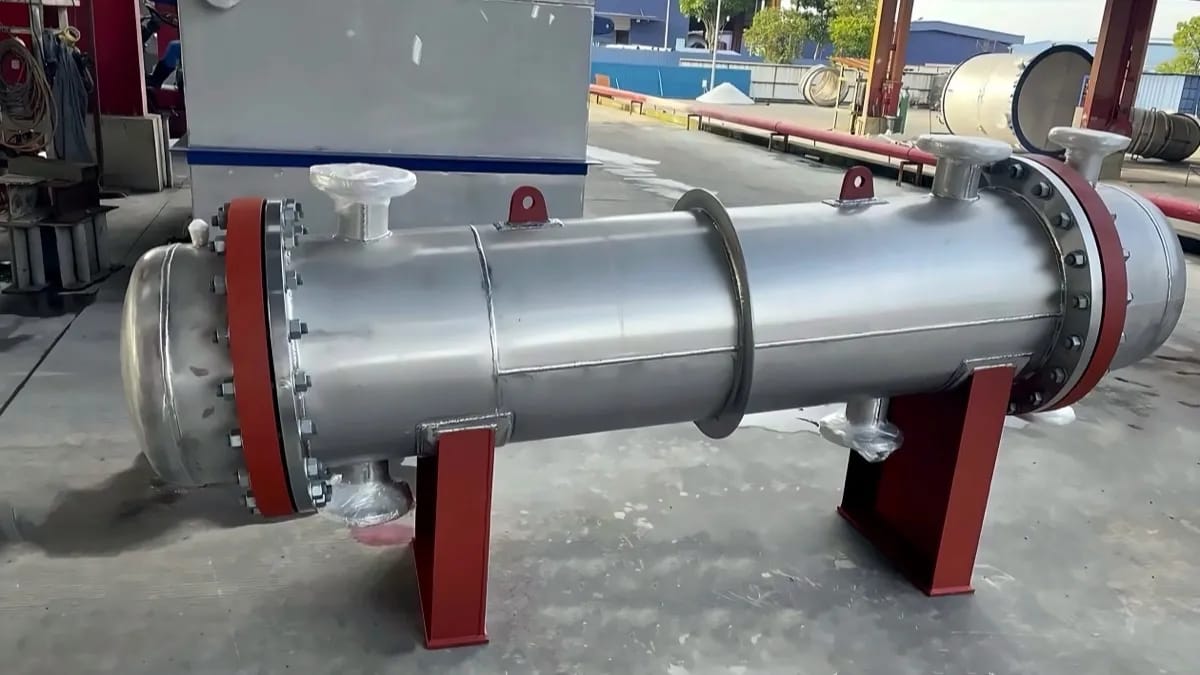
In chemical processing, hydrometallurgy, PTA (purified terephthalic acid) production, and chlor-alkali plants, process vessels and reactors operate under combinations of oxidizing chlorides, organic acids, elevated temperatures, and high pressures that destroy stainless steels and rapidly pit nickel-based alloys. When an unplanned shutdown in a continuous chemical complex costs USD 100,000 to USD 500,000 per day in lost production, titanium pressure vessels, reactors, and condensers deliver the lowest total cost of ownership over a 30-to-40-year design life.
However, designing and procuring titanium pressure equipment requires a clear understanding of ASME code limits, the economic crossover between solid titanium plate and explosion-clad steel plate, and the metallurgical behavior of titanium under heat and pressure.
Where Titanium Vessels Dominate Chemical Processing
1. PTA (Purified Terephthalic Acid) Oxidation Reactors and Condensers
PTA is the primary feedstock for polyester fiber and PET bottles. The catalytic oxidation of paraxylene uses acetic acid solvent with a bromine promoter at 190–210 °C and 1.5–2.0 MPa. Hot acetic acid contaminated with bromide ions is one of the most aggressive pitting and stress-corrosion environments in industrial chemistry. Type 316L stainless steel fails within weeks; Hastelloy C-276 experiences measurable corrosion rates requiring thick corrosion allowances. Titanium Grade 2, Grade 7, and Grade 12 exhibit corrosion rates below 0.005 mm/year, making explosion-clad titanium reactors and solid titanium overhead condensers the global standard for PTA plants.
2. Hydrometallurgical Pressure Acid Leach (HPAL) Autoclaves
Nickel-cobalt laterite ore processing relies on HPAL autoclaves operating at 245–270 °C and 4.0–5.5 MPa in sulfuric acid slurries containing high chloride levels. These massive vessels — often 5 meters in diameter and 35 meters long — use carbon steel shells explosion-clad with 8–10 mm of Grade 12 or Grade 7 titanium, with internal agitator shafts, nozzles, and dip pipes forged from solid Grade 5, Grade 7, or Grade 12 titanium.
3. Chlor-Alkali, Bleach, and Wet Chlorine Coolers
Wet chlorine gas from electrolysis cells is saturated with water vapor and chloride ions. Titanium forms a self-healing $\text{TiO}_2$ passive film in wet chlorine with virtually zero corrosion, whereas steel, copper alloys, and stainless steels suffer catastrophic attack. Vertical and horizontal shell-and-tube wet chlorine coolers fabricated from Grade 2 titanium plate and seamless ASTM B338 tubing operate for 30+ years without retubing.
4. Urea Strippers, Nitric Acid Condensers, and Adipic Acid Vessels
In hot nitric acid (up to 70% concentration and 180 °C) and carbamate stripper service, Grade 2 and Grade 7 titanium condensers eliminate the intergranular corrosion and frequent tube plugging that plague stainless steel equipment.
Solid Titanium vs. Explosion-Clad Construction: The Economic Crossover
Because titanium cannot be fusion-welded directly to carbon steel — iron and titanium react in the molten weld pool to form brittle FeTi and $\text{Fe}_2\text{Ti}$ intermetallic phases that crack immediately upon cooling — pressure vessel designers choose between three construction methods:
| Construction Method | Typical Shell Thickness Range | Design Temperature & Vacuum Limit | Relative CapEx (25 mm Equivalent Wall) | Best Application Fit |
|---|---|---|---|---|
| Solid Titanium Plate | 3 mm – 20 mm | Up to 315 °C; full vacuum capable | 1.0x (Lower below 18 mm wall) | Low-to-medium pressure vessels, condensers, heat exchanger shells, small reactors |
| Loose Titanium Liner in Steel Shell | 2 mm – 4 mm liner inside thick steel | Below 150 °C; no vacuum service | 0.65x – 0.80x | Atmospheric or low-temp positive-pressure storage tanks and columns |
| Explosion-Bonded Clad Plate (Ti on SA-516 Gr.70 / SA-387) | 20 mm – 120+ mm total (2–8 mm Ti clad layer) | Up to 300 °C; full vacuum & cyclic pressure | 0.55x – 0.75x (Above 22 mm wall) | High-pressure reactors, HPAL autoclaves, large-diameter PTA columns |
The 18–22 mm Thickness Rule of Thumb
As a practical procurement guideline:
- When the required ASME pressure-retaining wall thickness is 18 mm or less, fabricating the vessel from solid Grade 2 or Grade 12 titanium plate is typically less expensive than clad construction. Even though solid plate uses more titanium, it avoids the cost of explosion bonding, double-layer batten-strip welding, and the complex NDT required at clad weld seams.
- When high internal pressure or large vessel diameter pushes the required wall thickness above 22 mm, explosion-clad plate (typically 3 mm to 6 mm of ASTM B265 Grade 2, Grade 12, or Grade 7 metallurgically bonded to ASME SA-516 Grade 70 carbon steel per ASTM B898) becomes significantly more economical. Carbon steel carries the mechanical pressure load while the thin titanium layer provides full corrosion immunity.
ASME Section VIII Design Considerations for Titanium
Titanium has two physical characteristics that vessel engineers must account for during ASME Boiler and Pressure Vessel Code (Section VIII, Division 1 and Division 2) calculations:
- Modulus of Elasticity ($E$): Titanium's Young's modulus is approximately 103–105 GPa at room temperature — roughly half that of carbon and stainless steel (~200 GPa). For vessels subject to external pressure or full vacuum, buckling resistance is governed by elastic modulus rather than yield strength alone. Titanium shells under vacuum therefore require closer stiffening ring spacing than steel shells of the same thickness.
- Allowable Stress Decline With Temperature: Commercially pure titanium loses yield strength steadily between 100 °C and 300 °C. Look at how ASME Section II Part D maximum allowable design stress compares between Grade 2 and Grade 12:
| Design Temperature | ASTM B265 Grade 2 Allowable Stress (MPa) | ASTM B265 Grade 12 Allowable Stress (MPa) | Grade 12 Wall Thickness Advantage |
|---|---|---|---|
| 40 °C | 98.6 | 137.9 | -28% thinner shell |
| 100 °C | 79.3 | 122.0 | -35% thinner shell |
| 150 °C | 62.7 | 106.2 | -41% thinner shell |
| 200 °C | 50.3 | 95.8 | -47% thinner shell |
| 250 °C | 42.1 | 88.3 | -52% thinner shell |
| 300 °C | 36.5 | 82.7 | -56% thinner shell |
At 200 °C, switching a solid titanium vessel design from Grade 2 to Grade 12 cuts the required shell thickness nearly in half. Because Grade 12 plate costs only ~30 percent more per kilogram than Grade 2, a Grade 12 vessel operating above 150 °C actually costs 15 to 25 percent less to build than a Grade 2 vessel while offering superior crevice corrosion resistance.
Critical Safeguards: What Titanium Cannot Tolerate
Before finalizing a titanium reactor or condenser specification, process engineers must verify that none of the following conditions exist:
- Dry Chlorine Gas: Titanium is completely immune to wet chlorine (>1.5% moisture), but reacts pyrophorically (ignites) in dry chlorine gas (<0.5% moisture). Never use titanium in dry $\text{Cl}_2$ service.
- Hydrofluoric Acid (HF) and Fluoride Ions: Even trace levels (tens of ppm) of free fluoride ions in acidic solutions (pH < 5) dissolve the $\text{TiO}_2$ passive film rapidly.
- Anhydrous Methanol: Pure methanol with less than 1.5–2.0% water content can cause stress-corrosion cracking in titanium. Always maintain at least 2% water inhibition if methanol is used for pressure testing or process flushing.
- Hydrogen Pickup Above 80 °C in Cathodic or Galvanic Couples: Avoid coupling titanium directly to active sacrificial metals (zinc, magnesium, aluminum, or carbon steel) in hot electrolytes above 80 °C, as nascent hydrogen generated at the titanium cathode can diffuse into the metal and form brittle titanium hydrides.
Supplying Mill Products & Prefabricated Vessel Components From BAOTI
Whether you are an EPC contractor designing a petrochemical complex or an ASME U-stamp pressure vessel fabricator bidding on a reactor replacement, BAOTI supplies both raw mill products and semi-finished vessel components:
- Extra-wide ASTM B265 / ASME SB-265 Titanium Plate in Grade 1, Grade 2, Grade 7, and Grade 12 (up to 3,000 mm width to minimize longitudinal shell welds)
- Explosion-Bonded Titanium Clad Steel Plate per ASTM B898 / ASME SA-263 (with ultrasonic 100% bond-integrity certification)
- Hot-Formed Dish Heads (Ellipsoidal & Hemispherical), forged ASME B16.5/B16.47 nozzle flanges, and machined tubesheets up to 3,500 mm diameter
- Seamless and Welded Condenser Tubing per ASTM B338 / ASME SB-338
Contact BAOTI's chemical equipment division with your vessel datasheet or bill of materials for plate nesting optimization and mill-direct quotation.
Frequently Asked Questions
When is explosion-clad titanium plate more economical than solid titanium for pressure vessels?
The economic crossover point typically occurs at a required wall thickness of 18 to 22 mm. Below 18 mm, solid titanium plate (Grade 2 or Grade 12) is generally cheaper because it avoids explosion-bonding fees and complex batten-strip welding. Above 22 mm, bonding a 3–6 mm titanium layer onto ASME carbon steel backing plate cuts material cost by 25–45%.
Why can't titanium be welded directly to carbon steel in a clad pressure vessel?
When titanium and iron mix in a molten weld pool, they form brittle intermetallic compounds (FeTi and Fe2Ti) that crack under cooling stresses. In clad vessel fabrication, the carbon steel backing is welded first, stripped back at the joint, fitted with a silver or copper inlay if required, and then sealed with a titanium batten cover strip welded only to the titanium clad layer.
Why does switching from Grade 2 to Grade 12 reduce titanium vessel cost above 150 °C?
Under ASME Section II Part D, Grade 12 (Ti-0.3Mo-0.8Ni) retains nearly double the maximum allowable design stress of Grade 2 at temperatures between 150 °C and 250 °C. This reduces the required shell and head thickness by 40–50%, which more than offsets Grade 12's ~30% per-kilogram material premium.
What chemicals must never be used in a titanium reactor or condenser?
Titanium must never be exposed to hydrofluoric acid (HF) or acidic fluoride solutions, dry chlorine gas containing less than 1.5% moisture (which causes pyrophoric ignition), fuming red nitric acid, or anhydrous methanol (<2% water), which can induce stress-corrosion cracking.
What ASME standards govern titanium plate and tubing for pressure vessels?
ASME SB-265 (identical to ASTM B265) covers titanium strip, sheet, and plate; ASME SB-338 (ASTM B338) covers seamless and welded heat exchanger and condenser tubes; ASME SB-381 (ASTM B381) covers titanium forgings for nozzles and flanges; and ASTM B898 governs reactive-metal clad plate.
Related Reading

Why Semiconductor Fabs Are Switching to Titanium: Applications in Wet Etch, CVD, and Ultra-Pure Fluid Systems
A technical overview of titanium's growing role in semiconductor manufacturing — covering wet etch baths, CVD chamber components, ultra-pure water systems, and CMP slurry delivery, with grade selection data and contamination control requirements specific to fab environments.

Titanium in Oil and Gas: Where It Outperforms Super Duplex and Nickel Alloys
An application-focused guide to titanium in upstream and downstream oil and gas — covering subsea risers, heat exchangers, downhole tools, and desulfurization equipment, with grade selection data and real-world case studies showing where titanium displaces super duplex stainless steel and nickel alloys.

Titanium vs Aluminum: When to Upgrade and When Aluminum Is Good Enough
A practical engineering comparison of titanium and aluminum alloys — covering strength-to-weight ratio, corrosion resistance, temperature limits, cost per part, and decision criteria for aerospace, marine, chemical, and medical applications.

Titanium Fasteners in Aerospace, Marine, and Chemical Processing: Application Case Studies and Specification Guide
An application-focused guide to titanium fasteners — bolts, screws, nuts, and studs — with real-world case studies from aerospace, marine, and chemical processing industries, grade selection tables, and procurement specifications per ASTM, AMS, and ISO standards.