
Welding and Custom Fabricating Titanium: Shielding Gas, Weld Color Inspection, and OEM Quality Standards
A practical engineering guide to GTAW (TIG) welding and custom fabricating titanium — covering inert gas shielding above 400 °C, AWS D1.9 weld discoloration acceptance criteria, filler wire selection, and how to qualify a titanium fabrication supplier.
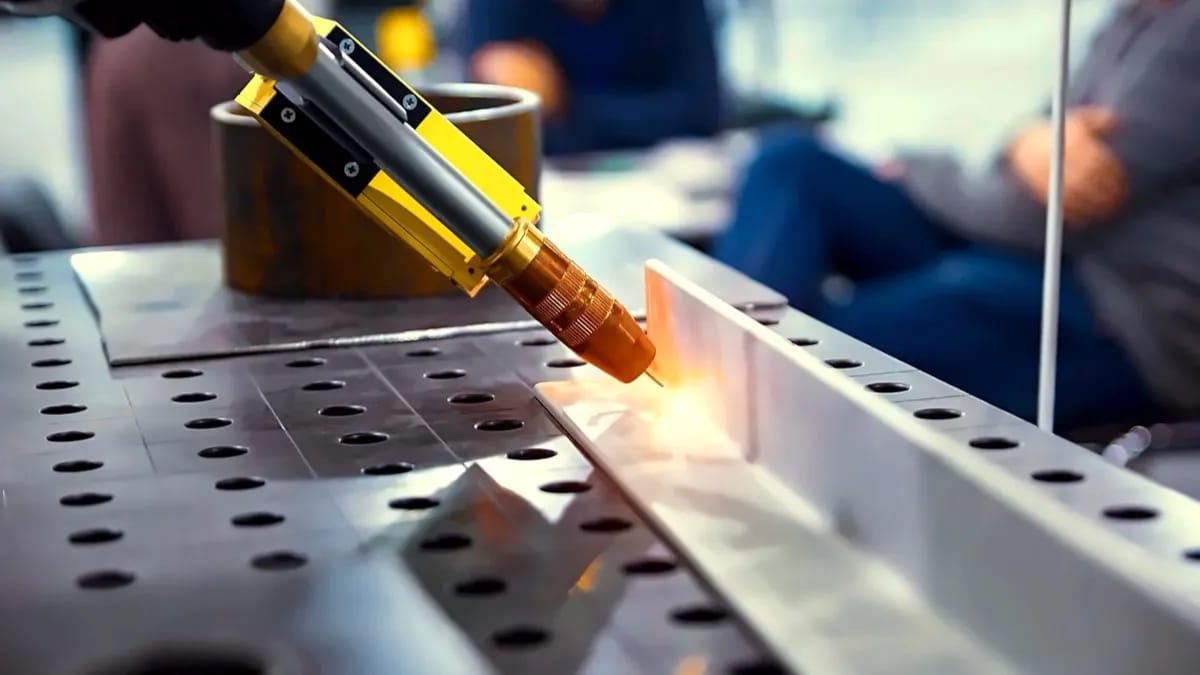
There is a widespread myth in general metalworking that titanium is harder to weld than stainless steel or nickel alloys. In reality, commercially pure titanium (Grades 1–4) and alpha-beta alloys like Grade 5 (Ti-6Al-4V) and Grade 9 (Ti-3Al-2.5V) have excellent weld pool fluidity and lower hot-cracking sensitivity than many austenitic stainless steels. What makes titanium fabrication unforgiving is a single metallurgical threshold: above 400 °C (750 °F), titanium rapidly absorbs oxygen, nitrogen, and hydrogen from the atmosphere.
Even trace atmospheric contamination during welding or hot forming embrittles the weld metal and heat-affected zone (HAZ), turning a ductile joint into a glass-like fracture initiation site. For engineering and procurement teams outsourcing custom titanium fabrication, understanding proper shielding practices, filler metal pairing, and visual weld color inspection is essential to ensuring zero-defect assemblies.
Why Atmospheric Contamination Destroys Titanium Welds
At room temperature, titanium's surface is protected by a tenacious 2–10 nm $\text{TiO}_2$ oxide film. When heated above 400 °C during GTAW (TIG), GMAW (MIG), plasma arc, or electron-beam welding, oxygen and nitrogen atoms dissolve rapidly into the crystal lattice at rates proportional to temperature.
- Oxygen and Nitrogen Pickup: Increase hardness and tensile strength locally in the weld bead while drastically reducing ductility and impact toughness. Once weld-metal oxygen exceeds ~0.30%, elongation drops toward zero and transverse cracks form under residual cooling stress.
- Hydrogen Pickup: Originates from moisture in the shielding gas, shop humidity, fingerprints, cutting oil, or solvent residues on the joint bevel. Absorbed hydrogen precipitates as brittle titanium hydride ($\text{TiH}_2$) platelets during cooling, causing delayed hydrogen-induced cracking days or weeks after fabrication.
The Three Zones of Inert Gas Shielding
Unlike stainless steel, where standard torch-nozzle argon shielding and a basic root purge are sufficient, open-air titanium GTAW welding requires three independent protection zones maintained with 99.999% pure argon (dew point below -50 °C) until the metal cools below 400 °C (and ideally below 260 °C / 500 °F):
- Primary Torch Shielding: Uses a large ceramic cup (#12 to #16, 19–25 mm diameter) equipped with a multi-layer gas lens diffuser to deliver laminar, non-turbulent argon flow over the molten weld pool. Excessive flow rate (>20 L/min without a gas lens) is a common mistake — it creates Venturi turbulence that pulls shop air into the arc.
- Trailing Shield: Because titanium has low thermal conductivity (~17–22 W/m·K for CP Grade 2 and ~6.7 W/m·K for Grade 5), heat dissipates slowly behind the moving torch. As the torch advances, the solidified weld bead remains above 400 °C for several centimeters. A contoured copper or stainless steel trailing shield fitted with a porous sintered bronze diffuser floods the cooling bead with argon until its temperature drops below the oxidation threshold.
- Back-Side (Root) Purging: The underside of a full-penetration weld and the adjacent HAZ also exceed 400 °C. Pipes, tubes, and vessels must be purged with dammed argon chambers or back-side purge shoes, verified with an electronic oxygen analyzer to below 50 ppm $\text{O}_2$ (and < 20 ppm $\text{O}_2$ for aerospace AMS 2681 applications) before striking the arc.
Visual Inspection: Reading the Titanium Weld Color Spectrum
Titanium provides a built-in thermometer and contamination gauge: as the surface oxide layer thickens from atmospheric exposure at high temperature, light interference produces a predictable sequence of colors. Both AWS D1.9 (Structural Welding Code — Titanium) and ASME B31.3 / Section VIII use weld surface coloration as the primary immediate acceptance test:
| Weld & HAZ Color | Oxide Layer Thickness | Metallurgical Condition | Industry Acceptance Decision |
|---|---|---|---|
| Bright Silver | < 10 nm | Zero measurable atmospheric pickup; full parent-metal ductility | Accept — Required for aerospace, medical, and high-pressure fatigue service |
| Light Straw / Pale Gold | 10 – 25 nm | Superficial surface film only; negligible effect on mechanical properties | Accept — Permitted for industrial piping and chemical vessels after wire brushing |
| Dark Straw / Bronze | 25 – 40 nm | Slight surface oxygen enrichment; subsurface metal generally unaffected | Borderline — Remove surface film mechanically and verify hardness; reject for critical cyclic service |
| Purple / Violet | 40 – 70 nm | Shielding lost while metal was 500–600 °C; measurable ductility loss in outer layer | Reject — Must be ground out completely to sound metal and re-welded |
| Dark Blue / Light Blue | 70 – 120 nm | Heavy oxygen/nitrogen diffusion during solidification; brittle alpha-case layer formed | Reject — Complete weld joint cutout required; wire brushing does NOT fix subsurface embrittlement |
| Gray / Powdery White Flakes | > 150 nm | Catastrophic atmospheric contamination while molten or white-hot | Reject — Cut back at least 15–25 mm into parent metal on both sides of the joint before re-welding |
Critical buyer warning: Never allow a fabricator to polish or acid-pickle away a blue, purple, or gray titanium weld to make it look silver before inspection. The color is merely the surface symptom; the oxygen has already diffused into the weld metal matrix. A contaminated weld that has been ground bright will still fail brittlely in service. Always require in-process weld logs or pre-pickling photo documentation on critical assemblies.
Filler Metal Selection Guide (AWS A5.16 / ISO 24034)
Matching the correct filler wire to the base metal grade is vital for controlling weld strength, ductility, and corrosion performance:
| Base Metal Grade | Standard Matching Filler Wire | Alternative / Upgraded Filler Wire | Key Engineering Note |
|---|---|---|---|
| Grade 1 (CP) | ERTi-1 | — | Lowest impurity level; maximizes weld bend ductility for deep-formed components |
| Grade 2 (CP) | ERTi-2 | ERTi-1 (for higher ductility) or ERTi-7 (for crevice corrosion) | Workhorse industrial filler; ERTi-2 must meet tighter interstitial limits than base plate to offset minor pickup |
| Grade 5 (Ti-6Al-4V) | ERTi-5 | ERTi-23 (Ti-6Al-4V ELI) or ERTi-2 (for lower-strength ductile fillet welds) | Using ERTi-23 filler on Grade 5 base plate improves weld fracture toughness significantly |
| Grade 7 (Ti-0.15Pd) | ERTi-7 | — | Never weld Grade 7 process surfaces with ERTi-2 wire, or the weld seam will suffer preferential acid corrosion |
| Grade 9 (Ti-3Al-2.5V) | ERTi-9 | ERTi-9ELI | Required for aerospace hydraulic lines and high-pressure manifolds |
| Grade 12 (Ti-0.3Mo-0.8Ni) | ERTi-12 | ERTi-7 (for severe crevice zones) | Matches elevated-temperature ASME strength and brine corrosion resistance |
| Grade 23 (Ti-6Al-4V ELI) | ERTi-23 | — | Mandatory for medical implants, cryogenic vessels, and fracture-critical aerospace structures |
Post-Weld Stress Relief for Alloy Grades
Commercially pure titanium (Grades 1, 2, 3, and 7) generally does not require post-weld heat treatment (PWHT) unless the assembly is heavily restrained or destined for environments prone to stress-corrosion cracking (such as anhydrous methanol or red fuming nitric acid).
By contrast, welded Grade 5 (Ti-6Al-4V) and Grade 9 assemblies develop high residual tensile stresses and acicular martensitic ($\alpha'$) microstructures in the fusion zone. Without stress relief, welded Grade 5 structures can experience distortion during subsequent finish machining or reduced high-cycle fatigue life. Standard stress relief for welded Grade 5 is 540–650 °C (1,000–1,200 °F) for 1 to 2 hours, performed either in a vacuum furnace or in an inert argon atmosphere to prevent alpha-case formation, followed by slow furnace cooling.
Checklist for Auditing a Custom Titanium Fabricator
When qualifying an OEM fabrication partner for titanium weldments, manifolds, frames, or process skids, verify these five capabilities:
- Dedicated Titanium Clean Room or Isolated Bay: Grinding carbon steel in the same room where titanium is prepared deposits iron dust onto the titanium surface. During welding, embedded iron particles melt into the titanium, creating localized Fe-Ti intermetallic pockets that act as pitting nuclei in chemical service and crack starters in aerospace service.
- Pre-Weld Chemical Pickling & Acetone/Alcohol Degreasing: Joint bevels must be machined or Carbide-burr dressed (never ground with alumina/silicon-carbide wheels used on other metals), pickled in an $\text{HF-HNO}_3$ solution to remove thermal oxides, and wiped with lint-free cloths and reagent-grade acetone immediately prior to welding.
- Electronic Dew-Point and Oxygen Analyzers: Every welding station should monitor purge gas oxygen ppm in real time rather than relying on timed purge guesses.
- ASME Section IX / AWS D1.9 / ISO 15614-5 Welder Qualifications: Request Procedure Qualification Records (PQRs) with documented bend tests, tensile tests, and interstitial chemical analysis (O, N, H) comparing parent metal to weld deposit.
- 100% Non-Destructive Examination (NDE): Liquid penetrant testing (PT per ASTM E165) for surface cracks and porosity, plus radiographic testing (RT) or phased-array ultrasonic testing (PAUT) for internal weld integrity.
Custom Titanium Fabrication at BAOTI
BAOTI operates dedicated, iron-free titanium fabrication bays equipped with walk-in argon glovebox welding chambers, automated orbital tube welders, plasma-arc keyholing systems for thick plate, and large vacuum stress-relief furnaces. Because we draw our own AWS A5.16 ERTi filler wire in-house from triple-melted VAR ingots, we guarantee complete chemical traceability across both parent metal and weld metal. Send your assembly drawings to our engineering team for a DFM (Design for Manufacturability) review and quotation.
Frequently Asked Questions
What weld colors are acceptable when TIG welding titanium?
Under AWS D1.9 and ASME standards, bright silver and light straw/pale gold are acceptable. Bright silver indicates zero atmospheric contamination and is required for aerospace and medical parts. Purple, dark blue, and gray or white powdery welds indicate oxygen and nitrogen embrittlement while the metal was above 400 °C and must be completely cut out and re-welded.
Can a blue or purple titanium weld be fixed by wire brushing or acid pickling?
No. Wire brushing or pickling a blue or purple weld only removes the thin surface oxide film that creates the color; it does not remove the oxygen and nitrogen atoms that have already diffused into the weld metal lattice. A discolored weld that has been polished silver remains brittle and must be ground out to sound base metal.
What filler wire should be used to weld Grade 5 (Ti-6Al-4V) titanium?
Grade 5 titanium is typically welded with AWS A5.16 ERTi-5 filler wire, or ERTi-23 (Ti-6Al-4V ELI) filler wire when higher weld fracture toughness and ductility are required. Because welded Grade 5 develops residual stress and martensitic alpha-prime phases, a post-weld vacuum stress relief at 540–650 °C for 1–2 hours is strongly recommended.
Why must titanium welding be separated from carbon steel fabrication?
Airborne iron particles from grinding or cutting carbon steel can settle onto titanium weld bevels. During welding, even microscopic iron contamination forms brittle Fe-Ti intermetallic pockets that cause weld cracking and act as severe galvanic pitting sites in chemical or marine service.
What shielding gas is required for welding titanium?
Welding titanium requires 99.999% high-purity argon (or an argon-helium mix for deep penetration) with a moisture dew point below -50 °C. Shielding must cover three zones — the primary torch cup, a trailing shield over the solidifying bead, and a back-side root purge maintained below 50 ppm oxygen — until the metal cools below 400 °C.
Related Reading

Sourcing Custom Titanium Machined Parts: Tolerances, Surface Finishes, and OEM Ordering Guide
A practical procurement guide for buyers ordering custom CNC-machined titanium parts — covering achievable ISO 2768 tolerances, surface finish specifications, near-net forging vs. bar-stock machining economics, and incoming quality inspection checklists.

Titanium vs. Steel (Carbon and Alloy Steel): Strength-to-Weight, Density, and Lifecycle Cost
How does titanium compare against carbon steel and high-strength alloy steels like 4140 and 4340? This data-driven engineering comparison covers density, specific strength, elastic modulus, thermal properties, fatigue endurance, and total lifecycle economics.

Titanium vs Aluminum: When to Upgrade and When Aluminum Is Good Enough
A practical engineering comparison of titanium and aluminum alloys — covering strength-to-weight ratio, corrosion resistance, temperature limits, cost per part, and decision criteria for aerospace, marine, chemical, and medical applications.

Titanium Wire: Grades, Specifications, and Applications for Welding, Medical, and Industrial Use
A buyer's guide to titanium wire products — covering welding wire, medical wire, and industrial wire across CP and alloy grades, with size ranges per ASTM B863, spool packaging options, and ordering guidance.