
Titanium Wire: Grades, Specifications, and Applications for Welding, Medical, and Industrial Use
A buyer's guide to titanium wire products — covering welding wire, medical wire, and industrial wire across CP and alloy grades, with size ranges per ASTM B863, spool packaging options, and ordering guidance.
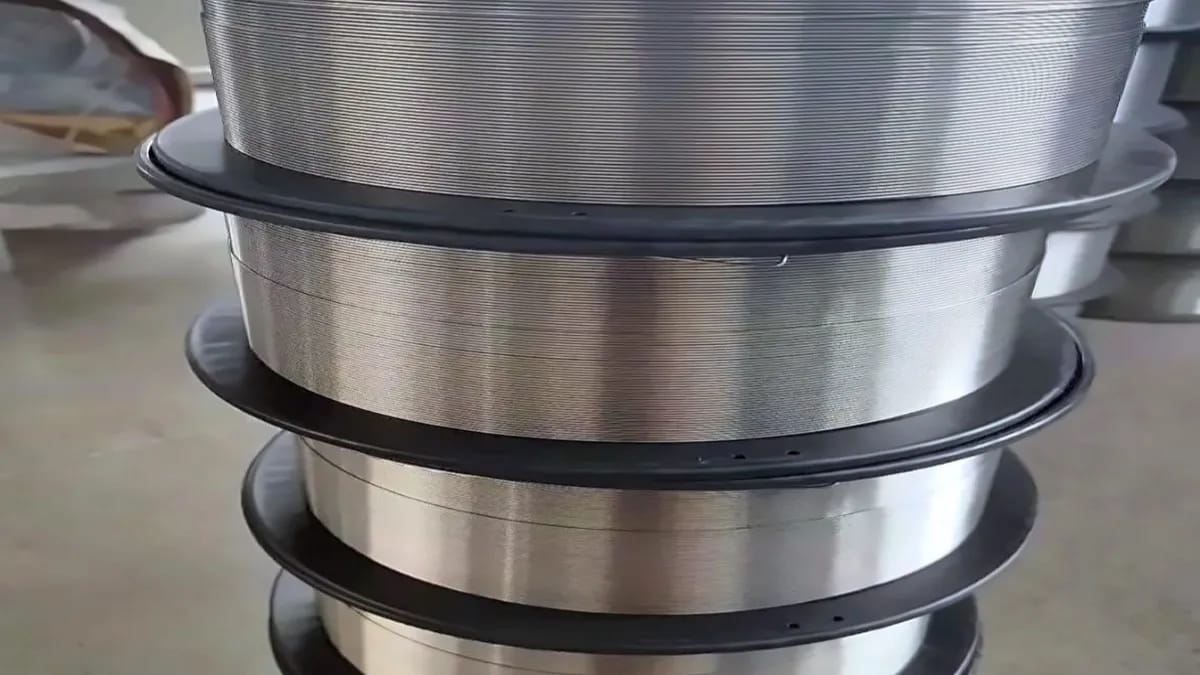
Titanium wire serves three distinct markets — welding consumables, medical devices, and industrial applications — each with different grade requirements, diameter ranges, and quality expectations. Selecting the wrong wire specification wastes material, compromises weld quality, or fails regulatory review. This guide helps procurement engineers navigate the options.
Wire Forms and Packaging
Titanium wire is supplied in three primary forms:
Straight-cut wire is precision-straightened and cut to fixed lengths (typically 914 mm / 36 in for welding rod, or custom lengths for medical applications). Straightness tolerance is critical for TIG welding filler rod — excessive curvature causes erratic feeding and inconsistent weld bead geometry.
Spooled wire is wound onto plastic or metal spools in continuous lengths for MIG/GMAW welding or spring manufacturing. Standard spool weights range from 2 kg to 15 kg depending on diameter. Layer-wound spooling (as opposed to random-wound) prevents tangling and ensures smooth feeding through wire drive systems.
Coiled wire is loosely coiled for large-diameter industrial applications such as mesh weaving, fastener heading, and electrochemical anode fabrication. Coil weights typically range from 10 kg to 50 kg.
Grade Selection by Application
| Grade | UNS | Typical Diameter Range | Primary Wire Applications |
|---|---|---|---|
| Grade 1 | R50250 | 0.25–3.2 mm | Corrosion-resistant mesh, electrochemical anodes |
| Grade 2 | R50400 | 0.5–4.0 mm | General welding filler, springs, filter elements |
| Grade 5 | R56400 | 0.5–3.2 mm | Aerospace welding, high-strength springs, fastener stock |
| Grade 7 | R52400 | 0.8–3.2 mm | Chemical process welding (Pd-stabilized for reducing acids) |
| Grade 9 | R56320 | 0.5–2.0 mm | Bicycle frames, hydraulic tubing welding |
| Grade 12 | R53400 | 0.8–3.2 mm | Heat exchanger tube welding |
| Grade 23 | R56407 | 0.1–1.6 mm | Medical guide wires, orthodontic archwires, surgical sutures |
| ERTi-2 | — | 0.8–3.2 mm | AWS A5.16 classified welding filler for Grade 2 base metal |
| ERTi-5 | — | 0.8–2.4 mm | AWS A5.16 classified welding filler for Grade 5 base metal |
Welding wire must match or undercut the base metal grade. The most common mistake is using ERTi-2 filler on Grade 5 (Ti-6Al-4V) base metal — the resulting weld has significantly lower strength than the parent material. Always match filler to base: ERTi-5 for Grade 5, ERTi-2 for Grade 2.
Medical wire demands tighter tolerances on diameter (typically ±0.01 mm), surface finish (electropolished to Ra < 0.4 μm), and cleanliness (ultrasonic cleaned, vacuum packed). Grade 23 (ELI) is the standard for implantable devices due to its superior fracture toughness and biocompatibility.
Standards and Specifications
| Standard | Scope | Industry |
|---|---|---|
| ASTM B863 | Titanium and titanium alloy wire | General industrial |
| AWS A5.16 | Titanium welding electrodes and rods | Welding consumables |
| AMS 4951 | CP titanium wire | Aerospace |
| AMS 4954 | Ti-6Al-4V wire | Aerospace |
| ASTM F67 | CP Ti for surgical implants | Medical |
| ASTM F136 | Ti-6Al-4V ELI for implants | Medical |
| ISO 5832-2/3 | Ti and Ti alloy for surgery | Medical (international) |
Diameter Tolerances (ASTM B863)
| Diameter Range (mm) | Tolerance (mm) |
|---|---|
| 0.25–0.50 | ±0.013 |
| 0.51–1.00 | ±0.020 |
| 1.01–2.00 | ±0.025 |
| 2.01–3.20 | ±0.038 |
| 3.21–5.00 | ±0.050 |
Tighter tolerances are available for medical and spring applications but add processing cost and lead time. If standard ASTM B863 tolerances meet your design requirements, specify them to keep pricing competitive.
Surface Conditions
| Condition | Process | Ra (μm) | Application |
|---|---|---|---|
| Pickled | Acid bath after drawing | 1.0–3.0 | General welding, industrial |
| Bright annealed | Drawn + vacuum anneal | 0.4–1.0 | Clean welding, springs |
| Electropolished | Electrochemical polish | < 0.4 | Medical devices, cleanroom |
| Oxide-free (shaved) | Surface shaving | 0.8–1.5 | Aerospace welding filler |
For welding applications, surface cleanliness is paramount. Contamination from residual drawing lubricant, oxide scale, or fingerprints introduces porosity and embrittlement into the weld. Always specify cleaned and vacuum-packed wire for welding, and handle with clean, lint-free gloves.
How to Order
A complete titanium wire order should specify:
- Grade and standard — e.g., "ASTM B863 Grade 2" or "AWS A5.16 ERTi-5"
- Diameter — in mm, with tolerance class (standard or special)
- Form — straight-cut (with length), spooled (with spool weight), or coiled
- Surface condition — pickled, bright annealed, electropolished, or shaved
- Temper — annealed (soft) or cold-drawn (spring temper)
- Quantity — total weight in kg or piece count for straight-cut
- Certification — EN 10204 3.1 or 3.2; add biocompatibility testing for medical
- Packaging — vacuum sealed for welding wire; cleanroom packaging for medical
Why Source Wire From BAOTI
BAOTI draws titanium wire from our own bar stock, controlling the process from VAR-melted ingot through hot rolling, wire rod production, and multi-pass cold drawing to final diameter. This vertical integration ensures consistent mechanical properties, surface quality, and lot-to-lot uniformity that wire resellers sourcing from multiple mills cannot guarantee.
For welding consumables, we supply ERTi-2 and ERTi-5 filler rod and spooled wire classified to AWS A5.16, with full chemical analysis and mechanical test data on every heat. For medical wire, we produce Grade 23 (ELI) wire to ASTM F136 with electropolished finish and complete traceability documentation required for device master files.
Frequently Asked Questions
What titanium wire grade should I use for TIG welding?
Use ERTi-2 (per AWS A5.16) for welding Grade 2 base metal, and ERTi-5 for welding Grade 5 (Ti-6Al-4V). Always match the filler grade to the base metal — using ERTi-2 on Grade 5 base metal produces a weld with significantly lower strength than the parent material.
What is the standard specification for titanium wire?
ASTM B863 covers titanium and titanium alloy wire for general industrial use. For welding consumables, AWS A5.16 applies. Aerospace applications use AMS 4951 (CP Ti) or AMS 4954 (Ti-6Al-4V). Medical wire follows ASTM F67 (CP Ti) or ASTM F136 (Ti-6Al-4V ELI).
What diameter tolerances are available for titanium wire?
Per ASTM B863, standard tolerances range from ±0.013 mm for wire under 0.50 mm diameter to ±0.050 mm for wire up to 5.0 mm. Tighter tolerances are available for medical and spring applications at additional cost.
Related Reading

Welding and Custom Fabricating Titanium: Shielding Gas, Weld Color Inspection, and OEM Quality Standards
A practical engineering guide to GTAW (TIG) welding and custom fabricating titanium — covering inert gas shielding above 400 °C, AWS D1.9 weld discoloration acceptance criteria, filler wire selection, and how to qualify a titanium fabrication supplier.

Sourcing Custom Titanium Machined Parts: Tolerances, Surface Finishes, and OEM Ordering Guide
A practical procurement guide for buyers ordering custom CNC-machined titanium parts — covering achievable ISO 2768 tolerances, surface finish specifications, near-net forging vs. bar-stock machining economics, and incoming quality inspection checklists.

Titanium vs. Steel (Carbon and Alloy Steel): Strength-to-Weight, Density, and Lifecycle Cost
How does titanium compare against carbon steel and high-strength alloy steels like 4140 and 4340? This data-driven engineering comparison covers density, specific strength, elastic modulus, thermal properties, fatigue endurance, and total lifecycle economics.

Titanium Pressure Vessels, Reactors, and Condensers: Design Standards and Solid vs. Clad Economics
An engineering and procurement guide to titanium chemical processing equipment — covering ASME Section VIII design rules, solid vs. explosion-clad construction crossover thickness, grade selection for corrosive media, and 30-year lifecycle cost comparisons.