
Titanium Bar and Rod: Grades, Specifications, and Sourcing Guide for Industrial Buyers
A buyer-oriented guide to titanium bar and rod products — covering common grades from CP Grade 2 to Ti-6Al-4V, standard sizes per ASTM B348, surface conditions, and practical advice for specifying and ordering titanium round bar, hex bar, and flat bar.
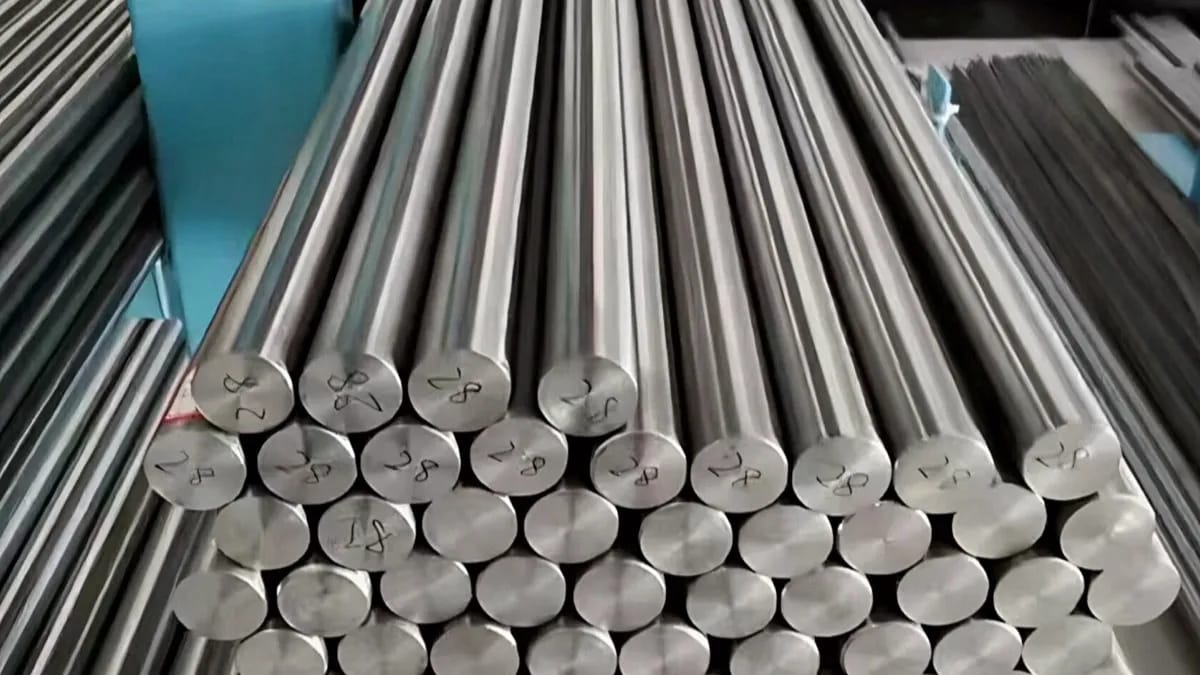
Titanium bar and rod are the starting stock for machined components across aerospace, medical, marine, and chemical processing industries. Whether your shop is turning Grade 2 valve stems or milling Grade 5 landing gear fittings, the bar you start with determines your scrap rate, tool life, and final part quality. This guide covers what procurement engineers and machine shop buyers need to know to specify titanium bar correctly.
Forms and Cross-Sections
Titanium bar stock is available in several cross-sectional profiles, each suited to different end uses:
Round bar is the most common form, accounting for roughly 70 percent of all titanium bar shipments. Available from 3 mm to 350 mm diameter, round bar is the standard starting stock for turned components, fasteners, and CNC-machined parts.
Hex bar is supplied in across-flat dimensions from 10 mm to 60 mm. It is specified primarily for valve components and fittings where the hexagonal shape provides a wrench-flat surface on the finished part without additional machining.
Square and flat bar are less common but serve specific applications — square bar for die blocks and flat bar for machined brackets, wear strips, and structural channels. Availability is typically limited to Grade 2 and Grade 5 in standard sizes.
Billet refers to large-diameter stock (typically above 150 mm) used as forging preforms or for large-diameter turned parts. Billets are supplied in the as-forged or forged-and-peeled condition and are generally ordered against a specific part drawing.
Grade Selection
| Grade | UNS | Composition | UTS (MPa) | YS (MPa) | Elongation (%) | Primary Bar Applications |
|---|---|---|---|---|---|---|
| Grade 1 | R50250 | CP Ti, low O | ≥240 | ≥170 | ≥24 | Chemical process internals, electroplating racks |
| Grade 2 | R50400 | CP Ti | ≥345 | ≥275 | ≥20 | Valve stems, pump shafts, general machined parts |
| Grade 5 | R56400 | Ti-6Al-4V | ≥895 | ≥828 | ≥10 | Aerospace structural, landing gear, engine mounts |
| Grade 7 | R52400 | Ti-0.15Pd | ≥345 | ≥275 | ≥20 | Wet chlorine service, HCl environments |
| Grade 9 | R56320 | Ti-3Al-2.5V | ≥620 | ≥483 | ≥15 | Hydraulic lines, high-pressure tubing preforms |
| Grade 23 | R56407 | Ti-6Al-4V ELI | ≥860 | ≥795 | ≥10 | Medical implants (hip, knee, spinal), cryogenic |
Grade 2 is the workhorse — if your application does not require the strength of an alloy grade, Grade 2 offers the best combination of machinability, weldability, and cost. It machines roughly 30 percent faster than Grade 5 and costs 40–50 percent less per kilogram.
Grade 5 (Ti-6Al-4V) is specified whenever strength-to-weight ratio is the primary driver. At 895 MPa tensile strength and 4.43 g/cm³ density, it delivers a specific strength that no steel or aluminum alloy can match. The trade-off is lower machinability and higher raw material cost.
Grade 23 (ELI) is essentially Grade 5 with tighter interstitial limits — lower oxygen, nitrogen, and iron content. The result is improved fracture toughness and fatigue resistance, which is why it dominates medical implant applications where long-term biocompatibility and mechanical reliability are non-negotiable.
Applicable Standards
Titanium bar is manufactured and certified to several overlapping specifications depending on the end-use industry:
| Standard | Scope | Industry |
|---|---|---|
| ASTM B348 | Bar and billet, all grades | General industrial, chemical processing |
| AMS 4928 | Ti-6Al-4V bar, annealed | Aerospace |
| AMS 4967 | Ti-6Al-4V bar, STA (heat-treated) | Aerospace, high-strength applications |
| ASTM F67 | CP Ti bar for surgical implants | Medical |
| ASTM F136 | Ti-6Al-4V ELI bar for implants | Medical |
| ISO 5832-2 / 5832-3 | Ti and Ti-6Al-4V for surgery | Medical (international) |
For general industrial use, ASTM B348 is sufficient. Aerospace programs typically require AMS specifications with additional controls on microstructure, ultrasonic inspection, and lot traceability. Medical applications add biocompatibility testing and demand full material traceability from ingot to finished bar.
Standard Sizes and Tolerances
Diameter Range and Tolerance (Round Bar, ASTM B348)
| Diameter Range (mm) | Tolerance (mm) |
|---|---|
| 3.0–10.0 | ±0.10 |
| 10.1–25.0 | ±0.15 |
| 25.1–50.0 | ±0.25 |
| 50.1–100.0 | ±0.40 |
| 100.1–200.0 | ±0.80 |
| 200.1–350.0 | ±1.50 |
Standard lengths are 1,000 mm, 2,000 mm, 3,000 mm, and 6,000 mm. Random lengths (1,000–6,000 mm) are available at lower cost and shorter lead times — if your part blanks can be cut from variable-length stock, specifying random lengths saves 5–10 percent on material cost.
Surface Conditions
| Condition | Process | Typical Use |
|---|---|---|
| Forged + peeled | Hot forge → centerless grind or peel | Large diameters (>50 mm), forging preforms |
| Hot-rolled + pickled | Hot roll → acid pickle | General industrial, moderate surface finish |
| Cold-drawn | Cold draw through die → stress relieve | Tight tolerance, smooth surface for precision machining |
| Centerless ground | Grinding to h9/h10 tolerance | Aerospace, medical — best dimensional accuracy |
Cold-drawn bar commands a 15–25 percent premium over hot-rolled but delivers tighter diameter tolerance (typically h9), better surface finish (Ra < 1.6 μm), and improved straightness. For high-volume CNC turning where bar feeders require consistent diameter, cold-drawn is the right choice.
How to Order
A complete titanium bar purchase order should specify:
- Grade and standard — e.g., "ASTM B348 Grade 5" or "AMS 4928"
- Cross-section — round, hex, square, or flat
- Dimensions — diameter × length (or width × thickness × length for flat bar)
- Surface condition — hot-rolled, cold-drawn, centerless ground, or peeled
- Heat treatment — annealed (standard), STA (solution treated and aged), or mill condition
- Quantity — piece count or total weight in kg
- Certification — EN 10204 3.1 (standard) or 3.2 (third-party witness) for aerospace
- Inspection — ultrasonic testing per AMS 2631 or ASTM E2375 if required
- Marking — ink stamp with heat number, grade, and diameter; or tag-only
Common ordering mistake: Specifying Grade 5 bar without stating heat treatment condition. Annealed Ti-6Al-4V (AMS 4928) has different mechanical properties than STA condition (AMS 4967) — the STA condition delivers roughly 10–15 percent higher tensile and yield strength. If your design assumes STA properties but receives annealed bar, your parts will be under-strength.
Pricing Guidance
Titanium bar pricing follows the same structure as other mill products — sponge cost plus conversion cost plus margin — but bar adds grinding, drawing, or peeling costs that vary significantly by surface condition:
- Grade 2 hot-rolled round bar (standard sizes): USD 25–40/kg at volume
- Grade 2 cold-drawn round bar: USD 35–55/kg
- Grade 5 annealed round bar: USD 50–80/kg
- Grade 5 centerless ground: USD 65–100/kg
- Grade 23 (ELI) medical bar: USD 80–130/kg (includes biocompatibility documentation)
These are indicative ranges for mill-direct orders of 200 kg or more per size. Distributor pricing for small quantities (under 50 kg) typically adds 30–50 percent.
Why Source Bar Stock From BAOTI
BAOTI produces titanium bar from our own VAR-melted ingots through hot forging, rolling, and finishing — giving us full control over microstructure, grain flow, and mechanical properties from melt to shipment. Every bar ships with a mill test report documenting chemical composition, mechanical properties, and dimensional inspection against your specified standard.
For machining-intensive programs, we work with customers to optimize bar diameter selection that minimizes material removal while meeting the part's finished dimensions. A 5 mm reduction in starting diameter can cut material cost by 10–15 percent and reduce cycle time meaningfully on high-volume production runs.
Frequently Asked Questions
What is the most common titanium bar grade for general industrial use?
Grade 2 (commercially pure titanium) is the most widely used bar grade, offering the best balance of machinability, weldability, corrosion resistance, and cost. It machines roughly 30% faster than Grade 5 and costs 40–50% less per kilogram.
What standard governs titanium bar specifications?
ASTM B348 is the primary standard for titanium bar and billet across all grades for general industrial use. Aerospace applications typically require AMS 4928 (annealed Ti-6Al-4V) or AMS 4967 (STA condition). Medical implant bar follows ASTM F67 (CP Ti) or ASTM F136 (Ti-6Al-4V ELI).
What is the difference between hot-rolled and cold-drawn titanium bar?
Cold-drawn bar offers tighter diameter tolerance (h9 vs standard), better surface finish (Ra < 1.6 μm), and improved straightness compared to hot-rolled bar. It costs 15–25% more but is preferred for high-volume CNC turning where bar feeders require consistent diameter.
Related Reading

Sourcing Custom Titanium Machined Parts: Tolerances, Surface Finishes, and OEM Ordering Guide
A practical procurement guide for buyers ordering custom CNC-machined titanium parts — covering achievable ISO 2768 tolerances, surface finish specifications, near-net forging vs. bar-stock machining economics, and incoming quality inspection checklists.

Titanium vs. Steel (Carbon and Alloy Steel): Strength-to-Weight, Density, and Lifecycle Cost
How does titanium compare against carbon steel and high-strength alloy steels like 4140 and 4340? This data-driven engineering comparison covers density, specific strength, elastic modulus, thermal properties, fatigue endurance, and total lifecycle economics.

Welding and Custom Fabricating Titanium: Shielding Gas, Weld Color Inspection, and OEM Quality Standards
A practical engineering guide to GTAW (TIG) welding and custom fabricating titanium — covering inert gas shielding above 400 °C, AWS D1.9 weld discoloration acceptance criteria, filler wire selection, and how to qualify a titanium fabrication supplier.

Titanium Pressure Vessels, Reactors, and Condensers: Design Standards and Solid vs. Clad Economics
An engineering and procurement guide to titanium chemical processing equipment — covering ASME Section VIII design rules, solid vs. explosion-clad construction crossover thickness, grade selection for corrosive media, and 30-year lifecycle cost comparisons.