
Titanium Sheet and Plate Buyer's Guide: Grades, Sizes, Tolerances, and Ordering Tips
A concise reference for procurement engineers comparing titanium sheet and plate products — covering commercially pure and alloy grades, standard sizes per ASTM B265, surface finishes, and how to specify your order correctly.
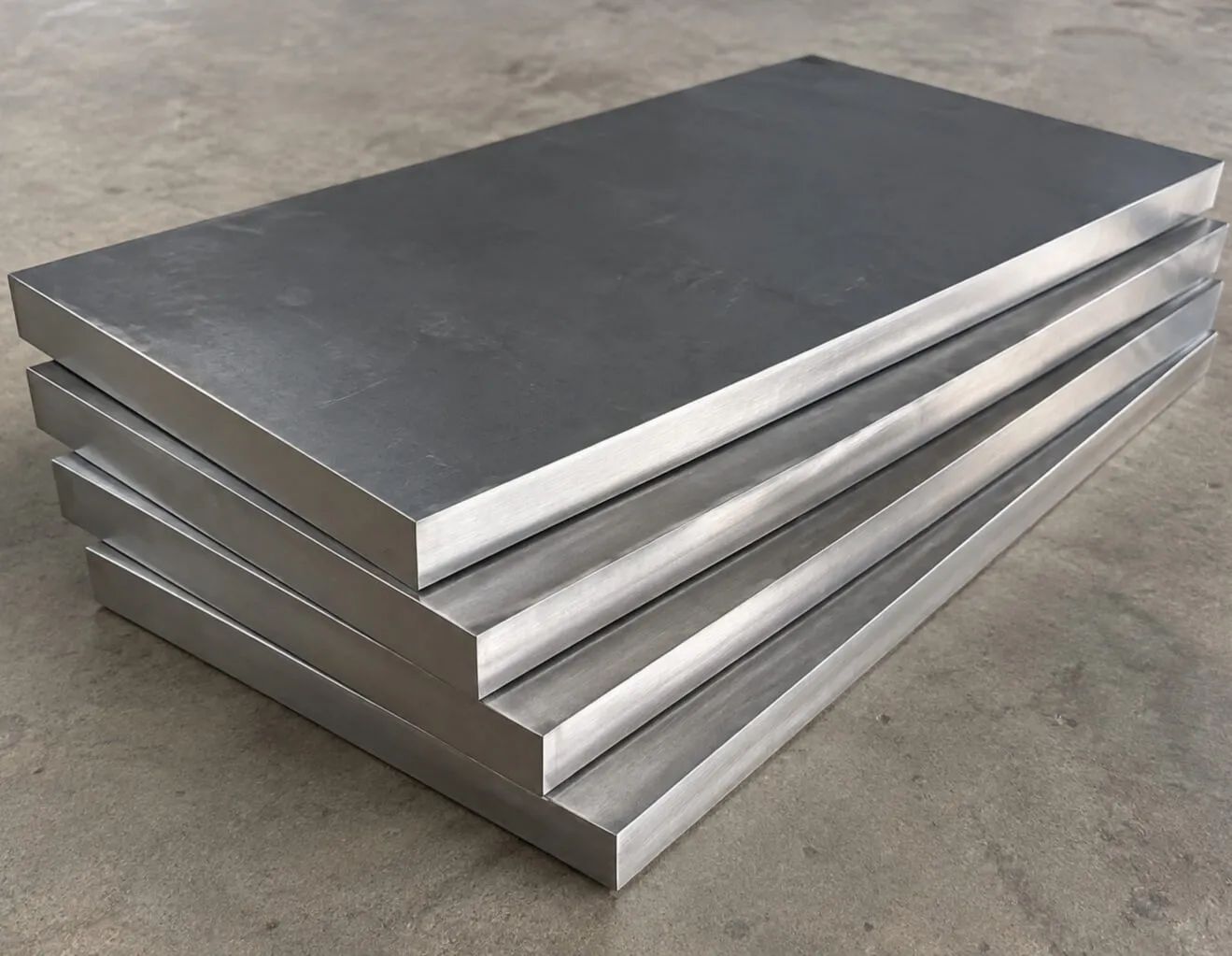
If your bill of materials calls for titanium flat products, the first decision you face is deceptively simple: sheet or plate? The answer determines pricing, lead time, available grades, and even which mill standards apply. This guide gives procurement engineers and design teams the reference data they need to specify titanium sheet and plate correctly the first time.
Sheet vs. Plate — Where Is the Line?
Industry convention follows ASTM B265: titanium flat-rolled product up to 4.75 mm (0.187 in) thick is sheet; anything above that threshold through 150 mm is plate. The distinction matters because mills price, stock, and certify these products differently.
Sheet is typically supplied in coil or cut-to-length rectangles and is cold-rolled to final gauge. Plate is hot-rolled or forged, then surface-ground or pickled. Because plate undergoes less cold work, it retains more of the ingot's original grain structure — an important consideration for fracture-critical aerospace applications where through-thickness toughness is specified.
Common Grades at a Glance
| ASTM Grade | UNS | Composition | Typical UTS (MPa) | Key Applications |
|---|---|---|---|---|
| Grade 1 | R50250 | CP Ti, low O | 240 | Chemical process linings, architectural cladding |
| Grade 2 | R50400 | CP Ti, standard | 345 | Heat exchangers, desalination, general industrial |
| Grade 5 | R56400 | Ti-6Al-4V | 895 | Aerospace structure, high-performance marine |
| Grade 7 | R52400 | Ti-0.15Pd | 345 | Wet chlorine service, PTA reactors |
| Grade 9 | R56320 | Ti-3Al-2.5V | 620 | Hydraulic tubing, thin-wall pressure vessels |
| Grade 12 | R53400 | Ti-0.3Mo-0.8Ni | 483 | Shell-and-tube heat exchangers, marine piping |
| Grade 23 | R56407 | Ti-6Al-4V ELI | 860 | Medical implants, cryogenic pressure vessels |
Grade 2 accounts for roughly 60 percent of all titanium sheet consumption globally because it balances formability, weldability, and corrosion resistance at a lower cost per kilogram than any alloy grade. Grade 5 dominates plate orders in aerospace, where the strength-to-weight ratio justifies the premium.
Standard Sizes and Tolerances
Sheet (≤ 4.75 mm)
Most mills stock Grade 2 sheet in these dimensions:
- Thickness: 0.5, 0.8, 1.0, 1.5, 2.0, 3.0, 4.0 mm
- Width × Length: 1000 × 2000 mm, 1219 × 2438 mm (4 × 8 ft), 1500 × 3000 mm
- Thickness tolerance: per ASTM B265 Table 5 — typically ±0.05 mm for gauges under 1.6 mm
Plate (> 4.75 mm)
- Thickness: 6, 8, 10, 12, 15, 20, 25, 30, 40, 50 mm (custom up to 150 mm)
- Width × Length: up to 2000 × 4000 mm (wider cuts possible from slab mills)
- Thickness tolerance: ±0.25 mm for plates under 25 mm; ±1 % for thicker sections
Tighter tolerances are available on request but add lead time and cost. If your design can accept standard mill tolerances, specify "ASTM B265 standard" to keep pricing competitive.
Surface Finish Options
| Finish | Process | Ra (μm) | When to Specify |
|---|---|---|---|
| Mill pickled | Hot roll + acid pickle | 3.0–6.0 | General fabrication, welded assemblies |
| Cold-rolled bright | Cold roll + anneal + light pickle | 0.8–1.6 | Architectural, medical device housings |
| Ground | Surface grinding | 0.4–1.0 | Tight flatness, critical sealing faces |
| Polished | Mechanical buff | 0.1–0.3 | Decorative, cleanroom equipment |
For chemical process equipment, mill-pickled finish is the standard — the passive oxide layer that forms during pickling actually improves corrosion resistance. Over-specifying a polished finish on industrial plate adds cost without performance benefit.
How to Specify Your Order
A complete purchase order for titanium sheet or plate should include at minimum:
- Grade and specification — e.g., "ASTM B265 Grade 2"
- Dimensions — thickness × width × length in mm or inches
- Quantity — number of pieces or total weight in kg
- Surface finish — pickled, cold-rolled, ground, or polished
- Heat treatment condition — annealed (standard for most grades) or mill condition
- Certification — EN 10204 3.1 MTR is standard; 3.2 with third-party witness for aerospace
- Edge condition — sheared, slit, or saw-cut (affects flatness near edges)
- Marking — ink stamp, vibro-etch, or tag-only per your quality system
Omitting any of these fields invites substitution or re-work. The most common ordering mistake we see is specifying Grade 5 without stating heat treatment — mill condition and annealed Ti-6Al-4V have measurably different ductility.
Pricing Factors to Watch
Titanium sheet and plate pricing is driven by four variables:
- Titanium sponge cost — the raw-material baseline, which tracks OREMET/VSMPO spot prices
- Grade complexity — alloy grades require vacuum-arc remelting; each remelt step adds cost
- Gauge and width — thinner gauges require more rolling passes; wider sheets need larger mills
- Order volume — mill-direct orders (typically 500 kg minimum per size) undercut distributor pricing by 15–25 percent
For budget planning, Grade 2 sheet in standard sizes typically runs 30–50 USD/kg at volume, while Grade 5 plate ranges from 55–90 USD/kg depending on thickness and certification requirements. These figures shift quarterly with sponge pricing, so always request a current quote.
Why Work With a Vertically Integrated Supplier
When your supplier controls the full chain — from sponge to ingot to rolled product to cut-to-size — you gain traceability that distributors cannot match. Every plate can be traced back to a specific ingot heat number, and mechanical test data comes from the actual production lot rather than a generic typical-values sheet. For aerospace and medical OEMs subject to AS9100 or ISO 13485 audits, this traceability is not optional — it is a qualification requirement.
BAOTI operates its own VAR melting, hot-rolling, cold-rolling, and finishing lines, which means we issue mill test reports against the exact material you receive. If your application requires dual certification (e.g., ASTM B265 and AMS 4911 for Grade 5 plate), both specs are tested and documented on a single MTR.
Next Steps
Whether you need ten sheets for prototyping or ten tons for a heat-exchanger project, start by sending us your specification and quantity. Our technical sales team will confirm grade availability, advise on the most cost-effective size to minimize scrap, and provide a firm quotation within 48 hours.
Frequently Asked Questions
What is the difference between titanium sheet and titanium plate?
Per ASTM B265, titanium flat product up to 4.75 mm (0.187 in) thick is classified as sheet, while anything thicker is plate. Sheet is cold-rolled to final gauge and available in coil or cut lengths; plate is hot-rolled or forged and then surface-ground or pickled.
Which titanium grade is best for general industrial sheet applications?
Grade 2 (commercially pure titanium) is the most widely used sheet grade, accounting for roughly 60% of global consumption. It offers an excellent balance of formability, weldability, and corrosion resistance at a lower cost than alloy grades.
What information should I include when ordering titanium sheet or plate?
A complete order should specify: ASTM grade and specification, dimensions (thickness × width × length), quantity, surface finish, heat treatment condition, certification type (e.g., EN 10204 3.1 or 3.2), edge condition, and marking requirements.
Related Reading

CNC Machining Titanium: Cutting Parameters, Tool Selection, and Cost Reduction Strategies for Production Shops
A practical engineering guide to CNC machining titanium alloys — covering why titanium is difficult to cut, optimal speeds and feeds for common grades, tooling strategies that extend tool life by 3–5x, and real-world cost data from production environments.

How to Choose Titanium Tubes and Pipes: Seamless vs. Welded, Grade Comparison, and Sizing Guide for Industrial Buyers
A practical decision guide for selecting titanium tubes and pipes — seamless versus welded manufacturing, grade-by-grade comparison for heat exchangers, condensers, and hydraulic systems, plus dimensional standards and ordering specifications per ASTM, ASME, and ISO.

Titanium Fasteners in Aerospace, Marine, and Chemical Processing: Application Case Studies and Specification Guide
An application-focused guide to titanium fasteners — bolts, screws, nuts, and studs — with real-world case studies from aerospace, marine, and chemical processing industries, grade selection tables, and procurement specifications per ASTM, AMS, and ISO standards.

Titanium Forging: Process Comparison, Grade Selection, and Cost-Per-Part Data for OEM Procurement
A data-driven comparison of titanium forging processes — open-die, closed-die, and precision forging — with mechanical property tables, grade-by-grade cost analysis, and procurement guidance for aerospace, medical, and industrial OEM buyers.